


In Baja, a university research project is never just about one plant. It is about whether that plant can be cooked, processed, sold or turned into fuel before someone else figures it out first.
Researchers at the Universidad Autónoma de Baja California Sur are studying salicornia, a salt-tolerant coastal plant known in some circles as ‘sea asparagus,’ for its potential uses in food, industry and energy. The work is part of a senior thesis project by José Damián Miramontes Chávez, a ninth-semester marine biology student who is documenting the plant’s characteristics and possible commercial applications.
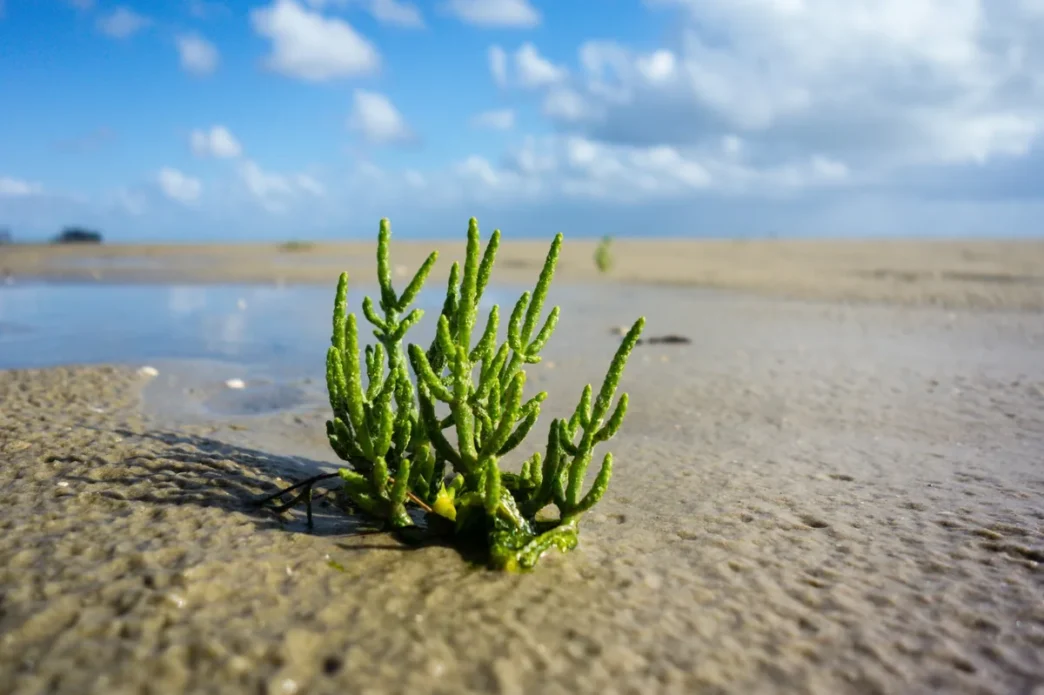
Salicornia grows where few other species can — in salt marshes, estuaries, mangroves and along beaches. It thrives in environments with high salinity, making it a natural fit for BCS coastal ecosystems. The species under study, Salicornia bigelovii, typically reaches 20 to 30 centimeters in height, with fleshy stems and small leaves that shift from green to yellow or reddish tones as the plant matures.
Culinary Uses Already Established Abroad
The plant’s most immediate appeal is edible. Its young shoots taste naturally salty and can be eaten raw, steamed, pickled or sautéed. In parts of Europe, salicornia is a recognized ingredient, often paired with seafood and fish. That same coastal-to-table aesthetic fits comfortably within Baja’s food culture, where chefs and markets already lean into regional ingredients.
According to the research, the plant’s naturally high salt content positions it as a potential substitute for table salt, offering a whole-food alternative with a milder sodium profile. For health-conscious diners and chefs looking to reduce processed sodium, salicornia presents a straightforward swap.
Industrial and Energy Applications on the Horizon
Beyond the kitchen, the plant offers industrial possibilities. Its ash contains compounds useful in glassmaking and soap production. The seeds yield oils that can be used in food processing or converted into biofuels. Previous studies have suggested these oils can generate energy output comparable to fuels used in aviation and specialized machinery, according to BCS Noticias.
That range — from biodiesel to bar snacks — makes salicornia an unusual case study in multi-use crops. The question for researchers is not whether the plant is versatile, but whether that versatility can be scaled in a way that makes economic sense for Baja producers.
Environmental Benefits and Ecosystem Role
Salicornia also plays a functional role in coastal environments. It helps stabilize shorelines, reduce erosion and filter nutrients from water. In wetland restoration projects, the plant is sometimes used to rebuild damaged habitats. Its tolerance for extreme salinity means it can grow in areas where conventional crops cannot, opening possibilities for agricultural use on marginal land.
The UABCS research aims to provide a clearer picture of how local species perform under Baja conditions and what commercial pathways might be feasible. Miramontes Chávez emphasized that the work is about identifying practical applications rooted in regional ecosystems. For a state already known for producing oysters, salt and aquaculture innovation, salicornia represents another potential niche.
What Comes Next
The study is still academic, but its findings could inform future pilot programs or small-scale production efforts. Salicornia is already cultivated commercially in parts of Mexico, the United States and Europe. Whether Baja growers and chefs adopt it will depend on market interest, production costs and how well the plant fits into existing supply chains.
For now, the research adds salicornia to a growing list of underutilized coastal resources being reconsidered for their value. In a region where salt production is big business and sustainable food systems are a regular topic of conversation, a plant that grows in saltwater and tastes like the ocean might eventually find its audience.