


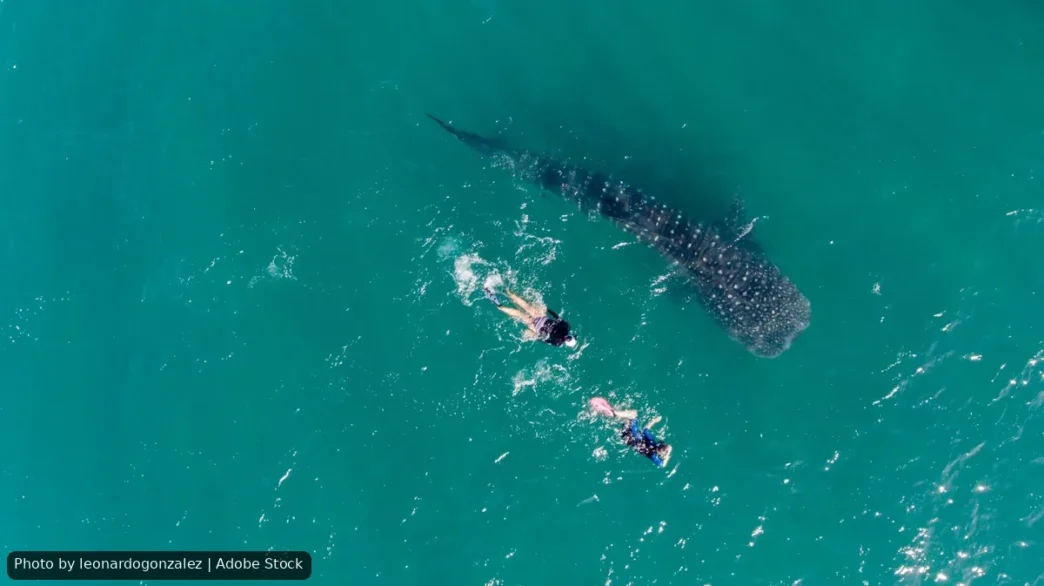
Visitors planning a whale shark tour in La Paz over the next few seasons now have a clearer rulebook to work with. Mexico’s environment ministry, known as Semarnat, has issued a new management plan that governs whale shark watching and swimming in La Paz Bay through three consecutive seasons: 2026–2027, 2027–2028 and 2028–2029, according to El Sudcaliforniano.
Previous plans covered a single season at a time. This is the first version to set rules three years out, though operators will still need to request a fresh authorization each season.
Why the Rules Keep Changing With the Whales
The number of boats allowed on the water each day is not fixed. Instead, it moves on a sliding scale tied to how many whale sharks are actually present, based on official counts overseen by Conanp, the federal agency that manages Mexico’s protected natural areas.
With six sharks counted as the reference value, up to six boats per shift and 24 per day are allowed. If counts reach 14 or more sharks, that climbs to 14 boats per shift and a daily maximum of 56, according to the published plan. If five or fewer sharks are spotted, tours are suspended entirely until numbers recover. That threshold carries over from last year’s rules, but the new plan spells out exactly how the reference number is calculated: the average of the two most recent official counts, rounded up.
Tour operators supply the boat, crew and local knowledge for these counts, while a Conanp-designated observer validates the results. Every permit holder is now required to take part in at least one monitoring outing per season, and Conanp will track compliance as a condition of the permit.
What Changes for Operators
One practical shift: backup vessels no longer have to belong to the same owner as the primary boat. A registered backup from another operator can now be used, as long as it meets the same operating requirements. That flexibility could matter during breakdowns or maintenance, when a fleet’s whale shark season in La Paz has historically hinged on a single boat being available.
The bay itself remains divided into three zones. Whale shark watching and swimming happen only in Zone I. Zone II is off-limits to tours and reserved for conservation, and Zone III allows only boat transit, capped at seven knots, or about 12.9 km/h (8 mph).
What Swimmers and Snorkelers Need to Know
For visitors booking a tour, the in-water rules are specific. Up to five swimmers can enter the water at a time under a guide’s supervision, wearing a full-torso life vest or wetsuit along with mask, snorkel and fins. Swimmers must stay at least two meters from the shark’s sides and head, and three meters from its tail, remaining together at the surface without diving underneath the animal.
Only one boat is allowed to work with a given shark or group at a time, for a maximum of 30 minutes, while other boats wait at least 50 meters away. Boats must approach from behind at an angle, moving parallel to the shark at no more than three knots. If a shark shows signs of stress, evasive swimming, tail-slapping, sudden turns or a deep, prolonged dive, guides are required to end the encounter immediately.
The code of conduct bans touching, riding, chasing or feeding the sharks, and blocking their path. Drones, propulsion devices, selfie sticks and underwater lighting are also prohibited during tours, consistent with the code of conduct that has applied to La Paz whale shark tours in recent seasons.
The Bigger Picture for La Paz Bay
Whale sharks, or Rhincodon typus, are the largest fish in the world, with some individuals reaching up to 20 meters (about 65 feet). Despite their size, they feed mostly on zooplankton, particularly copepods, and La Paz Bay draws them in thanks to unusually rich concentrations of that food source. Juveniles tend to stick to shallow coastal waters in the Gulf of California, while larger adults range into deeper, open-ocean areas.
The whale shark refuge area covering La Paz Bay was established in 2018 and spans roughly 22,749 hectares (about 56,220 acres), stretching from San Juan de la Costa to the mouth of the La Paz cove.
For visitors, the season typically runs October through April, though the actual start and pace of tours depends on when sharks show up in numbers. Anyone booking a trip should confirm their outfitter holds a current Conanp authorization, since quotas can tighten or tours can pause entirely depending on that season’s counts — a pattern regulars will recognize from years when the whale shark season in La Paz wrapped up earlier than expected.
Source Note: This story is based on original reporting by El Sudcaliforniano. It has been independently rewritten and adapted by the Gringo Gazette for our English-speaking readers, with additional context where appropriate.
