


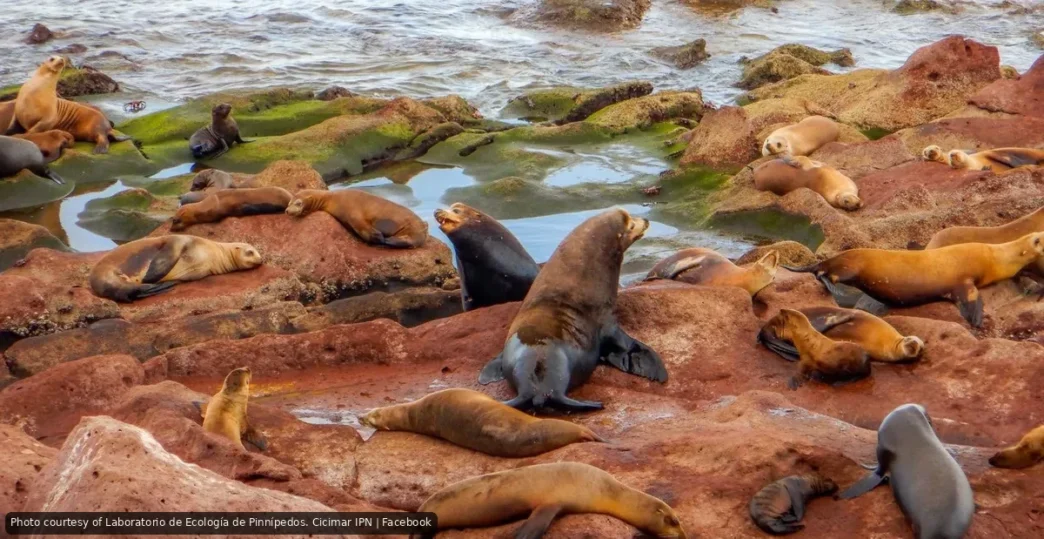
The California sea lions of La Paz can no longer be studied or managed as a single colony. New research shows that satellite sites across the bay are now functioning as connected resting areas linked to the main breeding zone at Los Islotes, a finding that requires expanded monitoring and potentially broader tourism controls.
The discovery comes from three decades of continuous field work by researchers at the National Polytechnic Institute’s Interdisciplinary Center for Marine Sciences (CICIMAR), who say the animals are showing behavioral flexibility that challenges older assumptions about how the population operates.
What Researchers Found
Claudia Janeth Hernández Camacho, a professor at CICIMAR’s Pinnipeds Ecology Laboratory, has been tracking the Los Islotes colony for 31 consecutive years alongside researcher Fernando Elorriaga Verplancken. When combined with earlier studies, the population now has more than 45 years of scientific documentation.
According to local reporting, the team has confirmed that sites including San Rafaelito, Tijeretas, San Francisquito and Las Ánimas are now part of a functional colony network centered on Los Islotes, where 738 sea lions were recently counted.
“Each year the animals surprise us with something,” Hernández Camacho said, explaining that the sea lions demonstrate notable flexibility in response to environmental conditions.
Los Islotes Remains Breeding Hub
Los Islotes continues to concentrate the majority of breeding activity. The site remains closed to tourism from June 1 through August 31 each year to protect females, pups and territorial males during the reproductive season.
During that period, males become markedly more aggressive as they defend breeding territories, a behavior that has led to attacks on swimmers and snorkelers in the past. The closure lifts September 1, allowing tour operators to resume sea lion encounters.
But the presence of resting colonies elsewhere in the bay means tourism activity, scientific study and conservation planning can no longer focus exclusively on a single site.
What It Means for Tourism and Conservation
The expanded colony network complicates tourism management. Operators working outside Los Islotes during the summer closure may still encounter sea lions using satellite sites, raising questions about whether seasonal restrictions should apply more broadly.
For researchers, the finding underscores the need for year-round monitoring across multiple locations rather than relying solely on counts at the traditional breeding grounds.
Hernández Camacho’s team has documented ongoing changes in the biology and behavior of La Paz sea lions over the course of the long-term study, changes that continue to reshape scientific understanding of the population.
As the animals adapt to shifting conditions in the Sea of Cortez, officials and tour operators may need to reconsider how and where sea lion activity is regulated across the broader bay system.
Source Note: This story is based on original reporting by El Sudcaliforniano. It has been independently rewritten and adapted by the Gringo Gazette for our English-speaking readers, with additional context where appropriate.
