

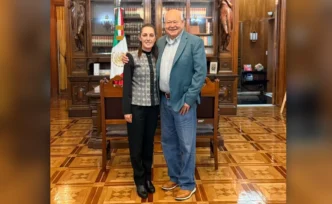
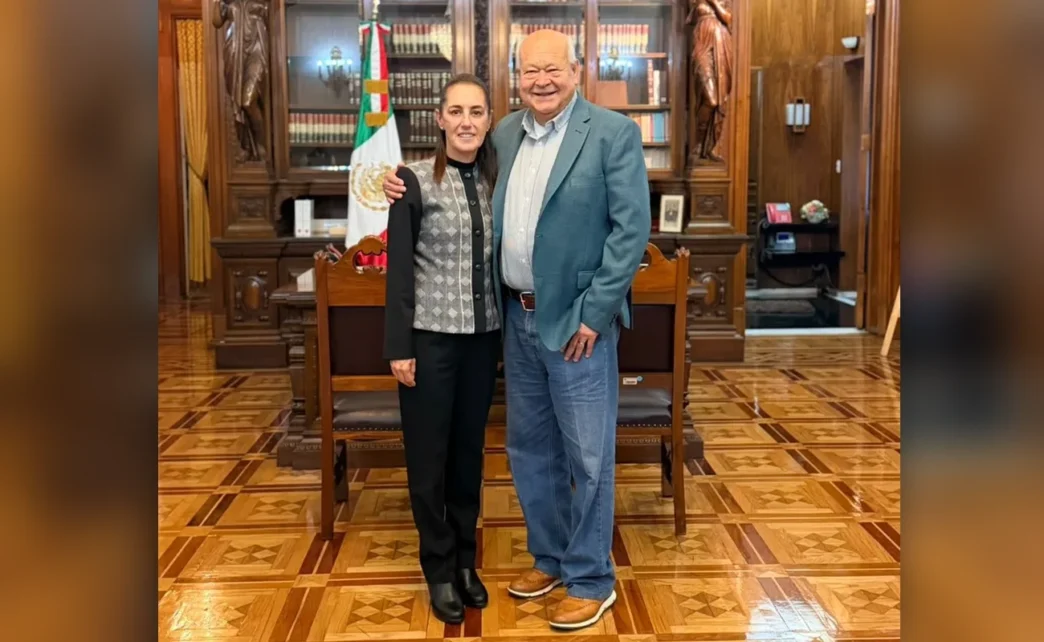
Governor Víctor Manuel Castro Cosío traveled to Mexico City this week for a working meeting with President Claudia Sheinbaum, and the two came away saying they would keep pushing a handful of priority projects for Baja California Sur. What those projects will actually cost, and when anyone will see a shovel in the ground, is a separate question that remains open.
According to a statement from the state government, the two leaders discussed the start of long-planned hydraulic works in the Valle de Santo Domingo, the agricultural zone in the municipality of Comondú that has spent years dealing with a stressed aquifer and heavy well extraction. They also reviewed progress on the Consultorios del Sistema Universal de Salud, known as SUS, a federal program meant to bring basic medical clinics closer to smaller communities and expand treatment options outside the state’s main hospitals, according to El Heraldo de México.
Castro Cosío described the sit-down in warmer terms than the subject matter might suggest. “Today I had the honor of speaking with our dear President of Mexico, our colleague Claudia Sheinbaum Pardo,” he said, calling it “a fraternal meeting that strengthens shared views and commitments as we keep building, together, the second floor of the Fourth Transformation,” a phrase Sheinbaum’s administration uses to describe the continuation of the political project started under former president Andrés Manuel López Obrador, according to the same report.
The governor also stressed the importance of keeping the federal government engaged on projects that address the state’s needs and, in his words, contribute to the well-being of residents of Baja California Sur. It’s the kind of language that shows up after almost every state-federal meeting, which is precisely why the actual follow-through matters more than the photo op.
Why the Water Project Is the One Worth Watching
Of the two items discussed, the Valle de Santo Domingo water works carry the most weight for people outside the meeting room. The valley supplies a significant share of BCS agricultural production, and the aquifer underneath it has been overdrawn for decades, a problem state and federal officials have acknowledged without fully solving. Any hydraulic infrastructure that actually gets built there would matter well beyond Comondú, since agricultural water use and municipal water use in Baja California Sur are connected through the same strained supply.
This meeting follows Sheinbaum’s visit to the state in September, when she laid out broader plans for federal investment in BCS, and it comes as the state continues to promote a broader portfolio of investment projects across the peninsula, according to recent state government announcements. Water infrastructure has been a recurring theme in that pipeline, echoing other recent efforts such as OOMSAPAS funding for water projects in other parts of the state.
What’s missing so far is the part that turns an agreement into a project: a budget line, a construction timeline, and an agency named to execute it. Those details tend to surface in later announcements, often closer to when federal budget allocations are finalized. For now, the honest summary is that the state and federal government agree these projects should happen, which is a necessary step but not the same as them happening.
Residents who have watched similar announcements come and go have reason for cautious interest rather than immediate celebration. The Santo Domingo Valley water works and the expansion of SUS clinics are both real needs, not symbolic gestures, which is exactly why it will be worth checking back once the state government or Comisión Nacional del Agua, Mexico’s federal water agency, releases actual figures and a construction schedule.
Source Note: This story is based on original reporting by El Heraldo de México. It has been independently rewritten and adapted by the Gringo Gazette for our English-speaking readers, with additional context where appropriate.