

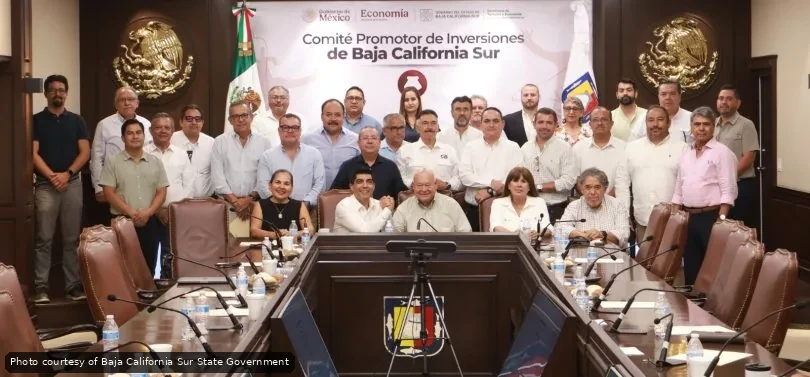
Baja California Sur’s state Investment Promotion Committee met last week to review a portfolio of 29 authorized projects, most of them concentrated in La Paz and Los Cabos, according to state officials.
Governor Víctor Manuel Castro Cosío led the session, which brought together representatives from the business, academic and government sectors to analyze proposals and opportunities aimed at generating employment and driving economic activity across the state.
Carlos Alfonso Candelaria López, head of the Secretariat of Economy’s Prospective, Planning and Evaluation Unit, outlined the project mix. Most proposals fall under temporary lodging services, construction and real estate activities, with additional investments in other sectors still under review.
In Baja, a project is never just a project. It is a promise, a budget, a ribbon-cutting photo and, eventually, a test of whether anyone remembered the maintenance plan.
Water and Energy on the Table
Participants agreed to coordinate on two recurring bottlenecks: the supply and distribution of potable water, and the generation and delivery of electric power. Both have long been friction points for developers and existing communities alike, especially during the high season when demand peaks.
The committee was installed in July 2025 as part of the national Plan México initiative, which seeks to encourage public and private investment and regional development across the country. The structure is designed to keep lines open between officials, investors and academics, streamline permitting and identify new economic opportunities.
What It Means for Residents
For property owners, business operators and anyone watching the pace of change in Los Cabos and La Paz, the announcement offers a snapshot of the pipeline — but not a construction schedule. Authorized does not mean funded, permitted or underway. It means the projects have been reviewed and, in principle, fit within state economic planning.
Governor Castro closed the session by emphasizing that the state has room to grow, provided that growth is orderly, respectful of natural resources and aligned with the productive character of each region. The question, as always, is whether the infrastructure can keep pace with the ambition.
The next committee session has not been announced. In the meantime, the 29 projects remain on paper, waiting for capital, permits and, in some cases, water.