


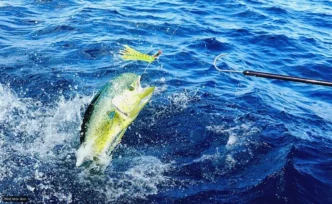

Three years without a fight is, in Mexican fisheries politics, practically a miracle. Since Senator Jesús Elenes Angulo floated a proposal in October 2023 to let commercial boats target dorado, sábalo (tarpon) and pez gallo (roosterfish), no new bill has tried to pry those species away from sport fishing. For an industry that has spent decades defending the same turf over and over, that silence counts as a victory.
Federal deputy Luis Armando Díaz, secretary of the Fishing Commission in Mexico’s Chamber of Deputies, says the absence of a new push is no accident. “I think we have made progress, and the main progress I would point to is that in these three years, under this legislature, nothing has moved forward to free up dorado for commercial fishing, even though it is a species reserved for sport fishing,” Díaz told El Sudcaliforniano.
Mexican law reserves six species for sport fishing exclusively within the first 50 nautical miles of coastline: marlin, sailfish, swordfish, tarpon, roosterfish and dorado, also known as mahi-mahi. Commercial boats are barred from landing them, and even filleted catches of these species are only supposed to go toward personal consumption or taxidermy. That 50-mile line is the whole ballgame for Los Cabos, where billfish and dorado are the main draw for the charter fleet.
The numbers explain why BCS legislators treat this as a bipartisan cause rather than a party issue. Según datos del Fondo para la Protección de los Recursos Marinos (FONMAR), sport fishing generates more than $150 million USD a year in Baja California Sur, and Díaz puts the share of Los Cabos tourism revenue tied to the activity at around 30 percent. A 2023 estimate from the Fundación Mexicana para la Conservación de los Peces Picudos, a billfish conservation group, put direct and indirect jobs tied to sport fishing in Cabo San Lucas alone at roughly 31,000.
A Fight With a Long Memory
This is not the first time Baja Sur has had to mobilize over dorado. In 2019, a Sinaloa congressman who then chaired the same Fishing Commission drafted legislation to open the species to commercial boats, prompting the foundation’s then-president to warn that losing dorado would ripple far beyond Los Cabos, since the fish migrate up and down the whole Gulf of California. Then-president Andrés Manuel López Obrador eventually promised, in a press conference from La Paz, that no release would happen.
The underlying tension goes back further. In 2007, Conapesca, the federal fisheries commission, opened a loophole allowing commercial boats to keep dorado caught “incidentally” while fishing for shark, supposedly capped at 30 percent of the haul. According to the foundation’s account, boats gamed the rule by switching to live bait meant to attract dorado rather than shark, then dumping the unwanted shark catch overboard. The result was years of declining dorado numbers and, in past tournament seasons, major tournaments in Los Cabos that had to be declared void because no marlin met the minimum size to qualify.
Díaz says the current crop of BCS federal legislators, regardless of party, has kept a united front against any repeat of that history. He also frames the fight as connected to, not opposed to, the interests of riverine and small-scale fishermen, who he argues are often used as the public face of commercialization pushes that mainly benefit intermediaries. “My position has basically been the defense of sport fishing, but also the rescue of riverine, traditional fishing,” he said.
Separately, Díaz says he is pushing federal port authorities, including the Administración del Sistema Portuario Nacional (Asipona) and the Capitanía de Puerto, the local maritime authority, to revisit new fees for boats operating in Cabo San Lucas bay that have unsettled the same charter operators this policy is meant to protect. That review is still pending, with no date set for a resolution. Coming on the heels of recent coverage of the sport fishing industry under pressure, it is one more reminder that the charter fleet’s bottom line depends on decisions made far from the dock, in Mexico City and in port offices alike.
For now, the dorado stays off the commercial menu, and Los Cabos anglers can keep booking charters without a new bill hanging over the season. The next test will be whether that three-year lull holds once Mexico’s Congress turns to other fisheries legislation, a cycle that, going by recent history, tends to repeat every few years whether anyone asks for it or not.