


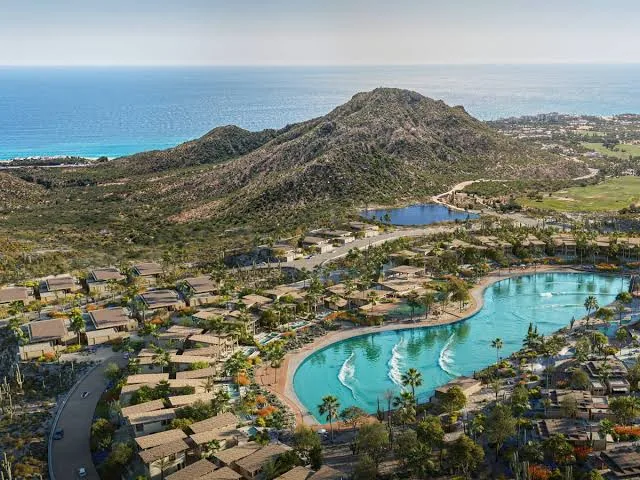
A groundbreaking surf and golf community is taking shape in Los Cabos, bringing the promise of North America’s first private wave basin and a reimagined luxury lifestyle to the Baja coastline. But beneath the glossy renderings and multimillion-dollar homesites, a harder question lingers: What does this kind of development mean for a region already struggling to keep the taps flowing?
Cabo Real Surf Club, officially launched in late 2024 by Meriwether Companies and the Sanchez Navarro family, has already generated more than $50 million in homesite sales. The project sits inside the established 3,000-acre Cabo Real master plan, wedged between the Sea of Cortez and the mountain foothills that define the Baja landscape. At its center is an Endless Surf wave basin, a pneumatic technology system designed to produce hundreds of customizable waves per hour with rides lasting up to 25 seconds and wave heights reaching seven feet.
The development also includes plans for more than 200 homes, ranging from custom estate lots to surf casitas and ocean-view villas, all anchored by a Robert Trent Jones II-designed championship golf course. Pricing starts at $2.5 million.
Why Cabo Real Surf Club Matters to Los Cabos
For Los Cabos, Cabo Real Surf Club represents both opportunity and tension. On one hand, it is the latest addition to a destination that has built its reputation on high-end tourism, luxury real estate, and year-round sunshine. The project is expected to open in 2026, bringing construction jobs, new property tax revenue, and yet another amenity to attract affluent buyers and travelers.
“My father acquired the land at Cabo Real in 1983 because of its beautiful beaches and ideal location between vibrant Cabo San Lucas and charming San Jose del Cabo,” Diego Sanchez Navarro, a partner in the Cabo Real master plan, told industry outlets. “With existing properties such as El Dorado Golf & Beach Club and Las Ventanas al Paraiso, it is fitting that Cabo Real will be home to the most exciting, next-gen community in the region.”
The surf technology itself is being marketed as sustainable and efficient, with wave production controlled digitally and water recirculated within the basin. Meriwether Companies, which is also developing similar amenities at Coral Mountain Desert Club in California, has positioned the project as a new standard for adventure-driven, wellness-oriented communities.
The Water Question Nobody Wants to Answer
But the timing is awkward. Los Cabos has spent the better part of the past decade grappling with water scarcity, drought cycles, aquifer depletion, and the increasing demands of a tourism economy that now welcomes millions of visitors each year. Previous coverage of the development has noted its ambitions but stopped short of examining what a private wave basin, golf course irrigation, and more than 200 homes will mean for regional water use.
Wave basins, even those that recirculate water, require significant initial fills and ongoing top-ups to compensate for evaporation, splash-out, and filtration losses. Golf courses in arid climates are notoriously thirsty, and luxury homes in Baja tend to feature pools, landscaping, and water-intensive fixtures. None of this is inherently reckless, but in a place where water stress is a known and worsening issue, the math becomes harder to ignore.
To date, developers have not publicly disclosed detailed water sourcing plans, usage estimates, or conservation commitments for Cabo Real Surf Club. That is not unusual for early-stage projects, but it is the kind of transparency that residents, environmental advocates, and municipal officials are increasingly demanding as water conservation efforts become more urgent across Baja California Sur.
What Residents Should Watch
The larger question is whether Los Cabos can continue to accommodate luxury developments without undermining the very resources that make the region livable. Water policy in Baja Sur is fragmented, enforcement is inconsistent, and desalination plants remain expensive and energy-intensive. Wealthy developments can afford their own solutions — private wells, onsite treatment systems, trucked water — but those workarounds do not solve the underlying problem.
For longtime residents and local businesses, the concern is not whether Cabo Real Surf Club will be a beautiful place. It almost certainly will be. The concern is whether projects like this will accelerate the day when water restrictions, rationing, or service interruptions become the norm rather than the exception.
As construction moves forward and the 2026 opening approaches, the story of Cabo Real Surf Club will be written in two chapters. One will celebrate innovation, investment, and the evolution of Los Cabos as a world-class destination. The other will ask whether the region is building a future it can actually sustain.