



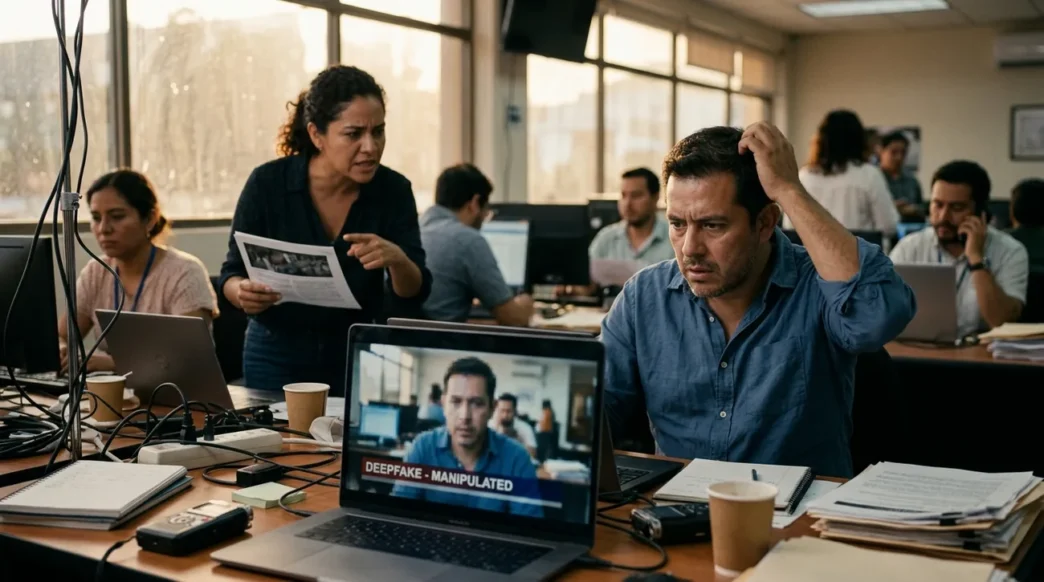
Giovanni Carlos, director of El Informante BCS, filed a criminal complaint this week after discovering that his voice and image were being used in AI-generated videos spreading disinformation about security issues in Baja California Sur.
The fake videos appeared on social media pages designed to mimic legitimate news outlets. According to local reports, at least two pages have circulated the deepfake content, with one identified as “Noticias del Finisterra” allegedly paying for promoted distribution across the state and Mexico City.
“Never have I needed artificial intelligence to say what I think,” Carlos said. “Those videos that are circulating are false.”
Not an Isolated Case
Carlos is not the only public figure targeted. State legislator Karina Olivas was also impersonated in fake videos addressing security topics, according to Heraldo de México. Lorena Hinojosa, a member of the National Chamber of the Restaurant Industry (Canirac), was similarly impersonated in false reports.
Carlos filed his complaint Tuesday at the Centro de Justicia Penal in La Paz. He told authorities he initially considered not pursuing legal action but changed his mind after a new deepfake video surfaced Monday claiming he had called for justice over a fabricated disappearance case.
“As a journalist, [security] is not a beat I cover precisely to avoid any kind of reprisals from organized crime,” Carlos said. “I don’t get involved in those topics, and I don’t have to demand justice on behalf of anyone.”
Political Motives Suspected
Carlos suspects the deepfake campaign has political motives tied to the 2027 election cycle. He suggested his journalism has made him a target for actors who find his voice “inconvenient.”
The complaint includes digital evidence and information about page administrators. Carlos said he has confidence in BCS’s Cyber Police unit to identify those responsible.
Baja California Sur’s penal code already addresses identity theft, including crimes committed through digital platforms, under articles 363 and 364. However, those provisions were originally designed to punish identity fraud for financial gain or property theft — not disinformation campaigns using artificial intelligence.
What Deepfakes Mean for Baja
Deepfake technology uses neural networks to generate realistic but fabricated audio and video. The tools have become more accessible in recent years, raising concerns about disinformation, fraud and public trust, according to security researchers.
The cases in BCS appear to be among the first documented incidents of AI-generated impersonation targeting local journalists and officials in the state. Enforcement mechanisms remain unclear, particularly when the technology is used for reputational damage rather than financial crimes.
Carlos urged the public to verify video sources and called on fellow journalists to report similar incidents. “Do not let yourselves be deceived,” he said.
Authorities have not announced arrests or identified suspects. The investigation remains active.