


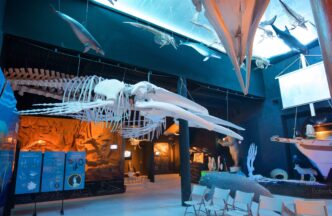

The Whale Museum and Marine Sciences in La Paz has been open for 31 years without core funding from public or private institutions, relying instead on admission fees and gift shop sales to sustain its work. The civic association opened Feb. 8, 1995, and is open to visitors Monday through Saturday from 9 a.m. to 2 p.m.
Francisco Gómez, the museum’s executive director, joined the project as a volunteer in 1997 under founder Víctor Ramos, who led the association during its first four years. Gómez recalled the museum’s origins and the determination behind its creation.
“The founding president was Víctor Ramos,” Gómez said. “He went door to door to bring the institution to life, gathering artists and community members and seeking resources to launch the museum. He led it only from its founding until 1999.”
The Museo de la Ballena y Ciencias del Mar is now considered one of Latin America’s leading institutions for marine mammal research and education. Its collection includes nearly 80 real skeletons of marine mammals, including blue whales, humpback whales and the critically endangered vaquita marina. The museum recently moved from its original Malecón site to a new downtown facility that also functions as an active research laboratory.
General admission is 80 pesos, or 100 pesos (about $5 to $7 USD) with a guided tour. Children under 4 enter free.
Visitors often recommend paying the small added fee for a guided tour. Guides, often marine biology students, offer detailed explanations of whale evolution, echolocation and regional conservation efforts in both English and Spanish. Exhibits include skeletons of orcas, sperm whales and a 12-meter gray whale suspended from the ceiling.
In addition to skeletal displays, the museum uses illustrations, photographs and videos to explain whale migration patterns along the Baja California Sur coast.
Guided by its motto, “conocer para proteger”, to know is to protect, the museum also serves as a center for specimen preparation and research into marine threats, including pollution and species extinction.