


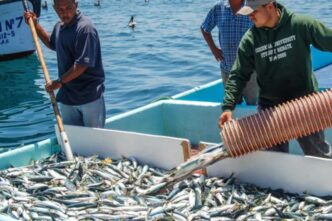

Baja California Sur harvested 197,000 tons of seafood in 2025, securing its position as the fourth-largest fisheries producer in Mexico, behind Sonora, Baja California, and Sinaloa.
According to data from the National Aquaculture and Fisheries Commission (CONAPESCA), the state’s fishing industry directly employs about 7,600 producers operating 3,900 small vessels along the Pacific and Gulf of California coasts.
“The state’s fishing sector generates an annual economic impact of around three billion pesos, with roughly 200,000 tons of seafood harvested each year,” said José Alfredo Bermúdez, Secretary of Agriculture, Livestock, and Fisheries of Baja California Sur.
This production represents about 10 percent of the total value of national fish output, which reached 19.3 billion pesos in 2024. He emphasized that the industry supports not only fishing but also processing, marketing, and distribution jobs.
Baja California Sur’s fisheries are distinguished by their diversity and presence in both domestic and international markets. One of the most important is the squid fishery, operating along a corridor from Mulegé to north of Santa Rosalía. During the February – March season, about 400 vessels capture an average of 250 tons of squid per day.
Because Santa Rosalía lacks freezing facilities, the squid must be transported to processing centers in Puerto San Carlos, Ciudad Constitución, Bahía Tortugas, Bahía Asunción, Isla Cedros, and Ensenada. This adds transportation costs and requires large amounts of ice shipped from Ensenada to preserve the catch.
In addition to squid, the state’s production includes finfish species such as grouper and mahi-mahi, which supply local and regional markets. These products are distributed mainly from La Paz and Los Cabos to tourist destinations and other parts of the country. The quality of Baja California Sur’s seafood is widely recognized, thanks to the favorable environmental conditions of the peninsula’s surrounding waters.
Coastal fishing dominates the industry, with small vessels operated by cooperatives and independent fishers who target species according to seasonal availability. Some independent fishers are still in the process of obtaining permits, a situation state authority are addressing through organizational and support programs aimed at formalizing their activities.
Fishing infrastructure across the state includes multiple landing sites and processing plants that add value before products reach the market. However, the northern region continues to face challenges due to limited freezing and storage capacity, which increases logistical costs.
Bermúdez noted that greater investment in infrastructure is essential to boost competitiveness and ensure fairer prices for producers.
Baja California Sur’s fishing sector is composed of both cooperatives and independent fishers. Cooperatives play a key role in harvesting high-value species such as lobster and abalone, much of which is exported at premium prices. Independent fishers focus on finfish and smaller-scale catches that serve local and regional demand, forming a diverse and vital part of the state’s economy.
