


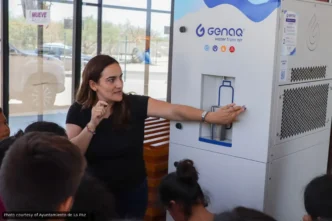
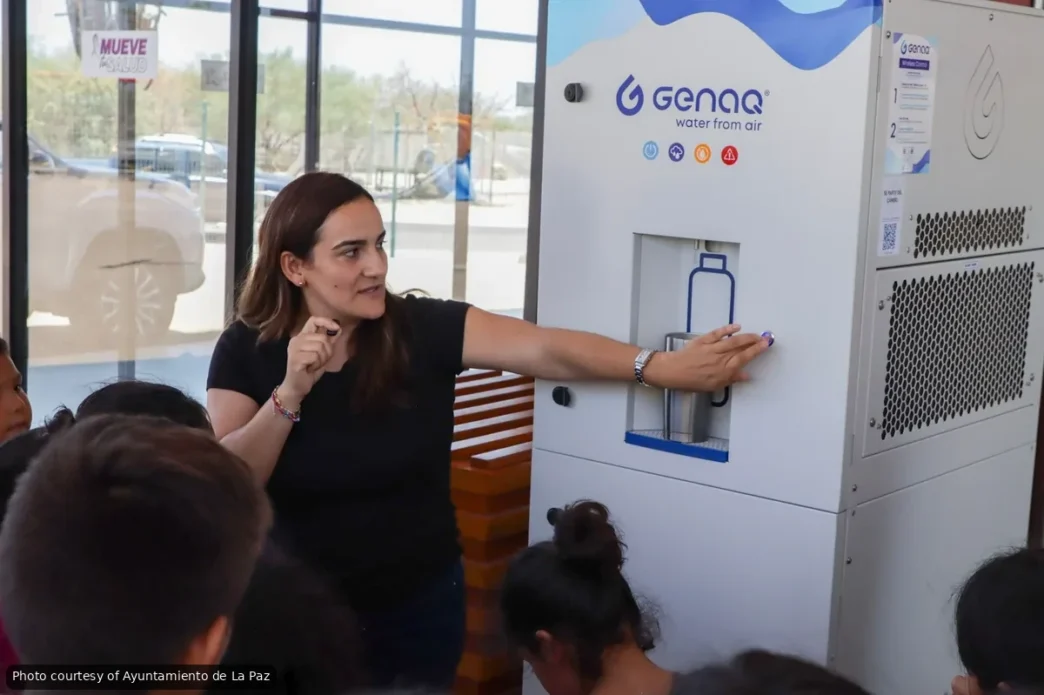
La Paz has installed what city officials are calling the first air-to-water drinking fountain in the municipality, a donated condensation unit now operating at the La Pitahaya sports complex. The system does not draw from pipes or wells. It pulls moisture from the air, filters it and dispenses drinking water at the press of a button.
Acting Mayor Amor Fenech Montaño introduced the equipment this week and said the city is watching closely. If the technology holds up through summer heat and public use, it could become a template for other high-traffic public sites.
“This water is not extracted from underground. It does not come through the pipeline. We are not filling a jug,” Fenech said during the announcement. “We are generating it here, from the air, with this equipment.”
The fountain works by condensing humidity from the surrounding atmosphere. Air is drawn into the unit, filtered through carbon and mineral stages, then stored in an internal 16-liter tank and an external 200-liter reservoir. The result, officials say, is fresh drinking water available on demand without tapping the strained municipal supply.
In a region where water scarcity has forced creative supply measures, the pilot project represents a small but symbolic shift. La Paz has worked to stretch resources through treated-water reuse and infrastructure upgrades. Now it is testing whether atmospheric moisture can add another layer of resilience, especially in public spaces where access to potable water matters most.
The fountain includes dispensers for both cups and refillable bottles, and the city has invited residents and athletes to try it. Fenech emphasized that the current installation is a trial. The equipment was donated, and municipal staff will monitor output, maintenance needs and user feedback over the coming months. Summer humidity should offer ideal conditions for the condensation system. Whether it performs as well during drier seasons is an open question.
La Pitahaya joins a growing network of public water access points across the city. According to local reports, La Paz now operates 12 drinking fountains at locations including Cerro Atravesado, the malecón and nine units in the El Piojillo neighborhood. The air-to-water model is the first of its kind in the city.
If the technology proves reliable and cost-effective, Fenech said the city could consider expanding the program to parks, athletic facilities and other public gathering points. The equipment requires electricity but no connection to municipal water lines, which could make it especially useful in areas where infrastructure is limited or where water pressure is inconsistent.
For now, the fountain at La Pitahaya is both a practical amenity and a proof of concept. In Baja, a project is never just a project. It is a promise, a budget, a ribbon-cutting photo and, eventually, a test of whether anyone remembered the maintenance plan. The air-to-water fountain will get its test this summer. Whether it becomes a model or a novelty depends on what happens when the humidity drops and the filters need changing.