


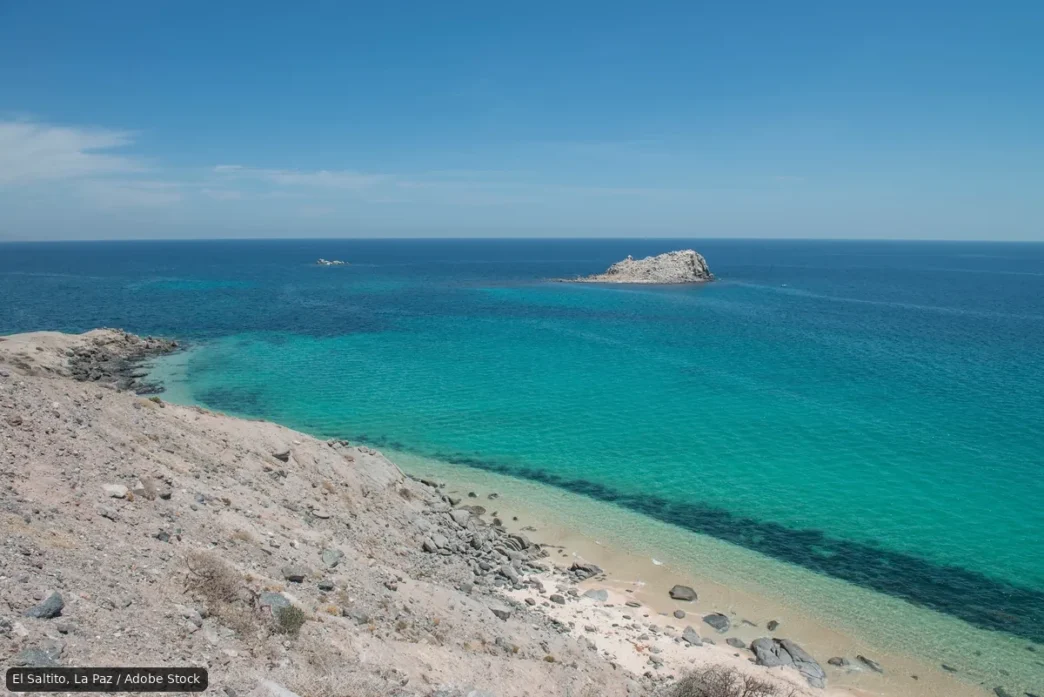
Nearly two decades after it first appeared on government desks, a proposed resort development at El Saltito is once again drawing scrutiny — this time for a request to clear 109 hectares of cardonal desert northeast of La Paz. Nine environmental organizations have formally asked federal regulators to deny the land-use permit, arguing that the developer has not met the legal requirements needed to justify dismantling more than a hundred hectares of native vegetation for a golf course, hotel, artificial water features and residential lots.
The site sits in the La Fortuna area, a zone that has become familiar to Baja residents who track coastal development disputes. For activists, this is not just another project. It is a test of whether environmental safeguards apply when developers propose large-scale changes to ecosystems that support endemic species and fragile water systems.
In Baja, a project is never just a project. It is a promise, a budget, a ribbon-cutting photo and, eventually, a test of whether anyone remembered the maintenance plan.
What the Developer Wants
The permit in question has been filed with the Dirección General de Gestión Forestal, Suelos y Ordenamiento Ecológico at SEMARNAT, Mexico’s environmental ministry. The applicant, Banco Ve Por Más acting as fiduciary for Fideicomiso 1,157, is seeking authorization to convert 109.622 hectares of forested land into what the company calls the Second Stage of El Saltito. The development would include a golf course, hotel with a private beach club, residential lots, roads, utilities and water infrastructure. Construction is projected to take 20 years.
Environmental groups, however, say the 109-hectare request is misleading. According to documents reviewed by local outlets, the broader El Saltito project was previously described to SEMARNAT as covering approximately 708 hectares. Activists argue that reviewing only a fraction of the site ignores cumulative environmental impacts and violates rules requiring comprehensive assessments of large-scale developments.
Why This Matters to Residents and Tourists
The site’s cardonal ecosystem — dominated by towering cactus species and scrub vegetation adapted to arid conditions — is home to species that do not exist anywhere else. Clearing that vegetation for fairways, landscaping and water features raises questions about biodiversity loss, erosion and the long-term viability of species that depend on intact desert corridors.
Then there is the water. Golf courses in Baja Sur are not new, but they are increasingly contentious. The state’s aquifers are under pressure, and debate over how much water golf courses actually use has become a recurring theme in municipal planning discussions. Adding a resort-scale course near La Paz, where water supplies serve a growing population and tourism economy, adds another layer of concern for local governments and residents who worry about long-term availability.
For foreign residents and tourists who come to Baja Sur precisely because of its desert coastline and relatively undisturbed landscapes, the question is practical: How many golf courses, hotels and artificial lagoons can the region absorb before the characteristics that draw people here begin to disappear?
A Long and Tangled Administrative Road
El Saltito is not a new controversy. The project has been active, dormant, revised and contested for nearly 18 years. That kind of timeline is not unusual in Baja development, where permits can lapse, developers can change hands and legal challenges can pause construction for years at a time. What makes this case notable is that it has survived multiple administrations and multiple rounds of public opposition without being definitively approved or canceled.
The coalition of environmental groups includes organizations with deep roots in Baja conservation work. Their petition to SEMARNAT argues that the developer has not proven it meets the legal standards required for a forest land-use change. Among the concerns they cite: insufficient analysis of hydrological impacts, inadequate consideration of protected species and failure to address the cumulative effect of fragmenting a large desert ecosystem into residential parcels and manicured turf.
What Happens Next
SEMARNAT’s forestry division will now review the application, the opposition filing and any supporting documentation. There is no fixed timeline for a decision, though federal environmental permits of this scale can take months or longer to resolve. The ministry has the authority to approve, deny or request additional studies before making a final call. Whether the project proceeds or stalls — again — depends on how regulators interpret the evidence and whether they accept the argument that 109 hectares can be evaluated separately from the larger 708-hectare footprint.
For residents who care about land use, water policy and the future of Baja’s desert coast, El Saltito is worth watching. It is a reminder that environmental decisions made today will shape the region for decades, and that the outcome rarely depends on what looks good on paper. It depends on who shows up, what the law says and whether officials choose to enforce it.