


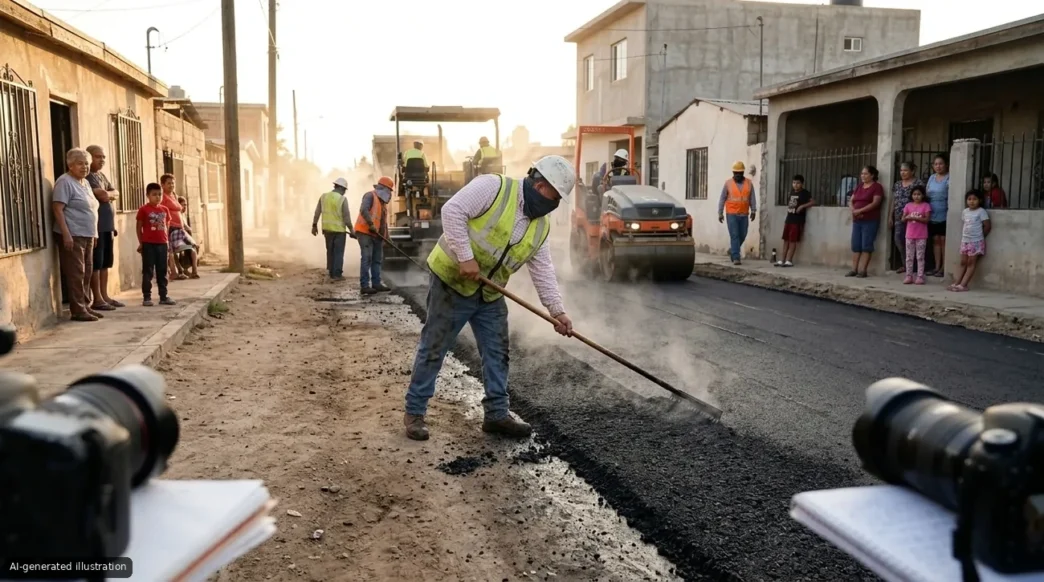
The Los Cabos municipal government announced what it calls a historic infrastructure and social investment package, promising 57 newly paved streets, 16 sports parks and 600 housing improvements funded through local trusts. According to municipal officials, most of the street paving is nearly ready for delivery, with construction underway on parks and housing upgrades across the municipality.
For many residents, the question is not whether the numbers sound impressive on paper. It is whether the projects will actually show up where people live, on schedule and built to last.
Carlos Castro Ceseña, director general of Social Development, told local reporters that funding is coming from the municipality’s own coffers, channeled through the Social Infrastructure Works Trust (FOIS) and the Environmental Sanitation Trust (FISAM). He said the 57 streets are nearing completion and the 16 sports and recreation facilities are in various stages of construction.
The 600 housing improvements include new rooms, roofs, concrete slabs and accessible bathrooms for an equal number of families. Castro Ceseña described the housing effort as complementary to federal programs and part of a broader strategy to reduce social inequality and improve living conditions for working-class residents.
The announcement follows a January plan by the city council to move forward with 20 paving projects and seven new parks this year, though it is unclear how much overlap exists between those earlier commitments and the current figures.
Beyond physical infrastructure, the municipality is also funding programs that fall outside its formal mandate. Castro Ceseña said the city is supporting 200 families with education monitors to help children who need specialized academic assistance. Another 5,122 families receive municipal scholarships to help students stay in school, even if they are attending classes outside Los Cabos.
The government also announced it is relaunching Escuelas con Cambio, a school improvement program that brings together officials, teachers, parents and students to upgrade facilities. As part of that effort, construction on nine school shade structures is expected to begin within the next two months, with each project budgeted at around 3 million pesos. Officials estimate the roofs will benefit roughly 12,000 students across nine campuses.
Castro Ceseña said the education initiatives position Los Cabos as a state leader in backing school infrastructure, even though education is not a core municipal responsibility under Mexican law.
What remains to be seen is how quickly the promised infrastructure improvements materialize in daily life. Residents have learned over the years that government announcements and ribbon cuttings do not always guarantee smooth roads, functional parks or timely housing repairs. In Baja, a project is never just a project. It is a promise, a budget, a photo opportunity and, eventually, a test of whether anyone remembered the maintenance plan.
The housing upgrades are intended to fill gaps left by federal programs, but locals will be watching to see whether the work reaches the families who need it most or gets bogged down in delays, contractor issues or budget reallocations.
For now, the municipality is moving forward with what it describes as a historic effort to address infrastructure backlogs. Whether the history books will remember it as a turning point or just another ambitious announcement depends largely on what residents see on their streets in the months ahead.