


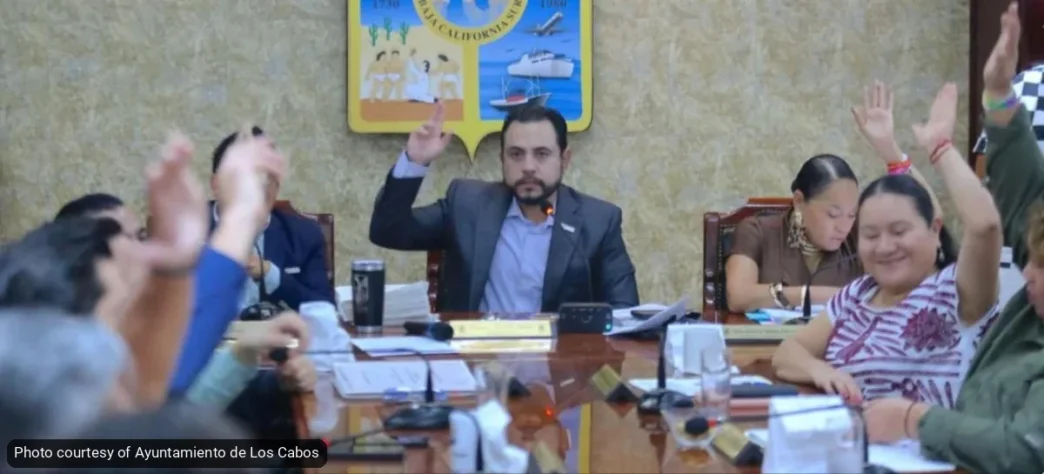
The Los Cabos city council has voted to send the state congress a 2027 revenue law proposal that expects to collect noticeably less money than this year, and the city points to a cooling real estate market as the main reason.
The projection, approved unanimously during the council’s 31st extraordinary session, pegs 2027 revenue at 6,746 million pesos (roughly $362.7 million USD), down from the 7,421 million pesos (about $399 million USD) built into this year’s modified budget, according to HOY BCS. That is a gap of 674.9 million pesos, or about $36.3 million USD, a 9.09% drop that is now on its way to the state congress for review. The city’s own bulletin lists a different 2027 total, 7,646 million pesos, which does not line up with the 9.09% figure; the numbers here follow the comparison in the proposal as reported by HOY BCS.
Mayor Christian Agúndez Gómez presented the initiative to the council, and the city’s own bulletin frames the decline as a deliberately conservative read of where revenue has actually been heading, not a worst-case guess. The sharper number is in the city’s own-source revenue, the taxes and fees Los Cabos collects directly rather than money passed down from the state or federal government. That figure is projected to fall from 4,173,085,240 pesos to 3,338,484,198 pesos, a drop of 834.6 million pesos, or roughly $44.9 million USD, close to a 20% decline, according to the city’s official statement, which attributes the figures to municipal treasurer José Manuel Araiza Araiza.
Where the Money Is Actually Shrinking
Strip out OOMSAPAS, the municipal water utility that runs its own books, and the city projects 5,590,741,118 pesos, about $300.6 million USD, available for general operations next year. That is the number that matters for anyone wondering whether Los Cabos can keep paving roads, running public works and covering payroll at the same clip as 2026.
According to Cabo Mil, the slide is tied mainly to a slower real estate market, which has already dragged down collection of the predial, Mexico’s annual property tax, and the ISABI, the tax charged when a property changes hands. Both are sensitive to how many transactions are actually closing, and fewer closings this year mean a smaller baseline going into 2027. It is a trend Gringo Gazette South has tracked before as the local property market shifted from boom-era momentum to something closer to a plateau.
The revenue document itself does not sugarcoat the risk, flagging the possibility that tourism, commercial activity and real estate could all soften further next year, which would only widen the gap. City officials have been careful to say the plan does not involve raising tax rates. Instead, the stated goal is to tighten collection of what residents and property owners already owe, closing gaps rather than opening new ones. That is a different proposition than the budget squeeze that forced the city to lean on short-term borrowing earlier this year, a move detailed in a $19 million loan approved to cover year-end bills.
None of this is final. The initiative now heads to the Congreso del Estado, Baja California Sur’s state legislature, which has to review and approve the revenue law before it becomes the official basis for next year’s municipal budget. Lawmakers could leave the numbers largely intact, or they could push back on specific assumptions, particularly the forecast around property-related taxes. Either way, the practical question for 2027 is whether a tighter revenue line translates into fewer public works projects, or simply a leaner version of business as usual. That answer likely will not be clear until the state congress finishes its review and the city publishes the budget it actually has to work with.