


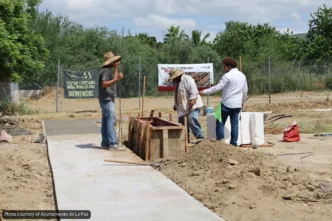
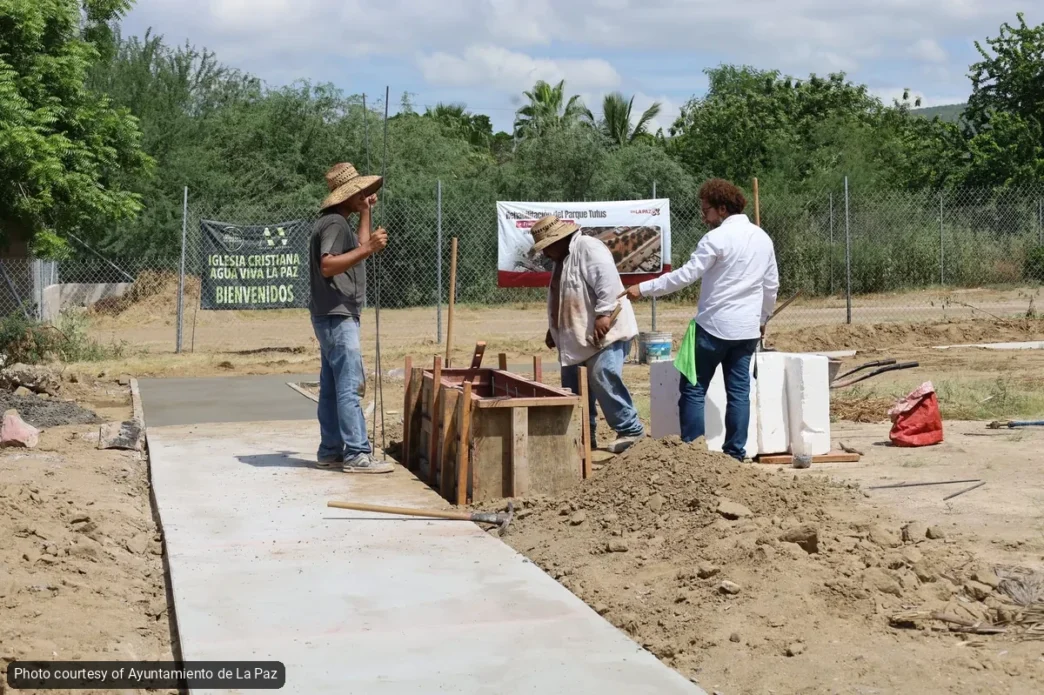
If your neighborhood park in La Paz has been looking a little tired lately, there is a decent chance a crew is already on the way. The municipal government has launched rehabilitation work in 16 parks spread across the city, part of a broader push to fix up public spaces that officials say had slipped into disrepair over the years, according to the city’s announcement.
The list is long enough that most corners of La Paz have a dog in this fight. Work is underway in Tutus, 3 de Mayo, Altamira, Palmar III, Lagunitas, Santa María, Península Sur, El Progreso, Antares, Misiones, Agua Clara, Centenario, Chametla, Villas de California, Valle del Mezquite and Revolución. That spread runs from older central colonias to newer developments on the city’s southern edge, which suggests this is less a single flagship project than a city-wide cleanup effort hitting a lot of neglected corners at once.
The price tag is modest by infrastructure standards: 625,000 pesos, or roughly $34,000 USD at current exchange rates, spread across all 16 sites. That is not a budget that buys new splash pads or dog parks. It is a budget that buys lighting, benches, walkways, playground repairs, fresh paint on curbs and ramps, perimeter fencing and a general cleanup of lots that had gone to seed.
What’s Actually Getting Built
Kenia Cervantes Villegas, the city’s director general of Comprehensive City Management (Gestión Integral de la Ciudad), said the work targets spaces that had fallen into neglect, with the goal of making them usable again for recreation and exercise. A few parks are getting more than a facelift. Centenario and Palmar III are each getting a new kiosk, Lagunitas is getting a shade structure installed over its open area, and the soccer field at Misiones park is getting goal protections and field maintenance so it is actually playable again.
For residents near these parks, the practical upshot is straightforward: better lighting means a park that feels usable after dark instead of abandoned to it, repaired playground equipment means fewer parents eyeing rusted swing sets with suspicion, and a fenced perimeter means less ambiguity about where the park ends and the street begins. None of it is glamorous. All of it is the kind of maintenance that, when skipped for years, is what turns a park into the kind of lot nobody wants to walk through after sundown.
This isn’t the only infrastructure push underway in the city. OOMSAPAS, the municipal water utility, has separately been working through a hydraulic project aimed at improving neighborhood water supply, and the utility recently reported deploying millions of liters of treated water across parks and streets citywide. Combined with paving work already underway in La Paz’s southeast, the parks rehab fits a pattern of smaller, distributed public works projects rather than one big-ticket showcase.
City hall has not announced a completion date for the full slate of 16 parks, and as with most municipal projects in Baja, the real test will be whether the lighting still works and the playground equipment stays intact a year from now. For the moment, the fix is in progress in all 16 colonias listed, and residents curious about their own neighborhood’s park can watch for crews showing up with paint, fencing and, in a few lucky spots, a brand-new kiosk.