

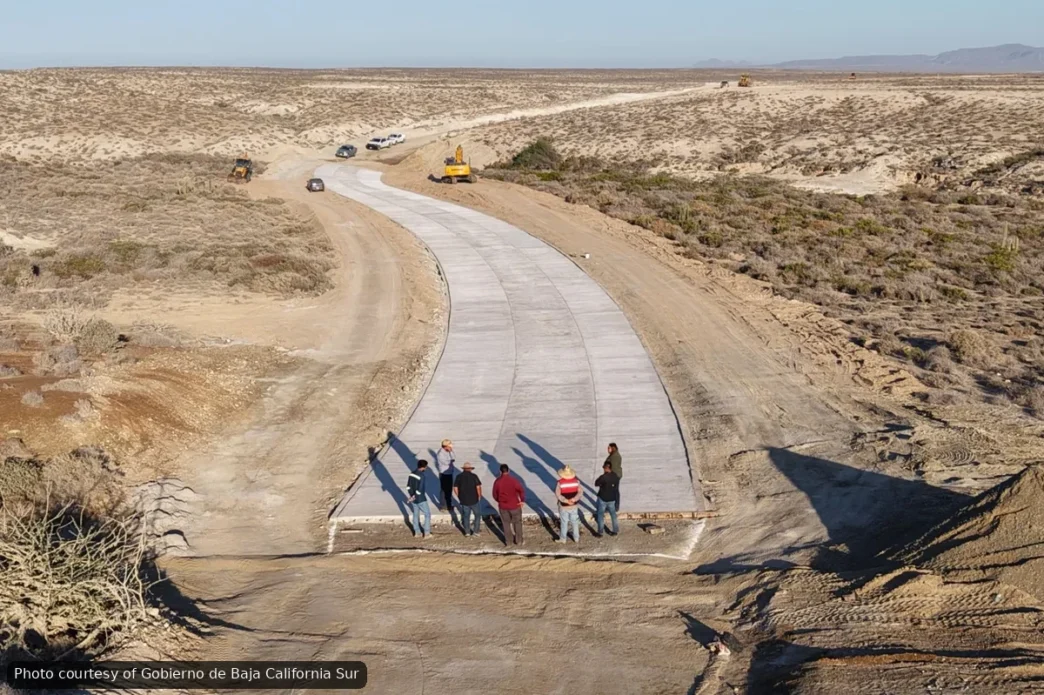
In Baja California Sur, a paved street or a new water line usually starts life as a line item in a fund most residents have never heard of. It is called FAIS, the Fondo de Aportaciones para la Infraestructura Social — a federal pool of money that flows to states and municipalities specifically for social infrastructure: roads, potable water, drainage, street lighting, schools and sports courts. For 2026, that pool shrank in Baja California Sur by 70 percent, and now local officials are bracing for the same cut to repeat in 2027.
The numbers tell the story plainly. BCS municipalities went from receiving 1,079.5 million pesos (roughly $61 million USD) in FAIS money in 2025 to just 320.5 million pesos (about $18 million USD) this year, according to figures reported by Semanario ZETA. State-level FAIS funding fell too, from 148.9 million pesos to 44.2 million. Add it up and Baja California Sur is short 863.7 million pesos this year alone — money that, in normal years, becomes visible as new pavement, potable water hookups and streetlights in the colonias that need them most.
Now the same reduction appears headed for 2027. La Paz’s interim municipal president, Amor Fenech, said the information she has received points to no relief. “Regarding FAIS, the information shared with me is that the budget will be the same as this year — in other words, the cut stays the same,” she said, according to El Sudcaliforniano. Governor Víctor Castro Cosío has separately put the projected 2027 hit at around 500 million pesos ($27 million USD), on top of what municipalities already absorbed this year, per BCS Noticias.
Mulegé’s mayor, Edith Aguilar Villavicencio, took the fight directly to the top. She traveled to La Paz during President Claudia Sheinbaum’s recent visit — the same trip that briefly closed streets around the Palacio de Gobierno — to hand-deliver a request asking the federal government to reconsider the reduction. She called FAIS the “motor” that lets municipal governments pave streets, bring potable water and drainage, and light up neighborhoods, adding that losing it means those needs simply go unmet.
Why the Cut Keeps Happening
The federal government’s explanation ties back to poverty formulas: BCS ranks among the states with the lowest extreme poverty, and FAIS distribution is calculated using poverty indicators. Castro Cosío argues that formula punishes a state that has made progress while ignoring population growth driven by hurricane recovery and migration. “The president should recognize the effort the state government has made to fight poverty,” he said to BCS Noticias, adding that the money “is still important for the municipalities to use.”
FAIS isn’t an isolated line item, either. It falls under Ramo 33, the broader federal transfer chapter that funds states and municipalities, and BCS took a 15 percent hit across that entire chapter in 2026 — including a 55 percent cut to the health fund, FASSA. BCS Senator Susana Zatarain (PAN) has called for a united front regardless of party, warning that a second consecutive FAIS cut lands especially hard given that hotel and restaurant activity in Los Cabos fell 47 percent during the recent low season. “There’s going to be less budget, and it’s going to bring Baja California Sur into a very complicated economic situation,” she said, according to meganoticias.mx.
What This Means for Local Projects
For readers, the practical takeaway is straightforward: FAIS money is the budget line behind unglamorous but essential work — street paving, drainage upgrades, and potable water connections in growing neighborhoods, the kind of projects tracked in past coverage of OOMSAPAS water investments and municipal mobility spending. When FAIS shrinks by 70 percent, municipalities either scale back those projects, delay them, or find alternate funding — and alternate funding hasn’t fully replaced what was lost, according to Castro Cosío, who noted that programs meant to offset the 2026 cut did not substitute for municipal public works money.
Federal deputy Luis Armando Díaz of the Labor Party has requested a meeting with the Chamber of Deputies’ Budget Commission to review the reduction ahead of the 2027 Economic Package debate. Whether that produces a reversal, a partial restoration, or another year of the same math remains to be seen — Congress typically finalizes the federal budget by November 15. For now, BCS mayors are doing what mayors do when the money doesn’t show up: writing letters, boarding flights to meet the president, and hoping someone in Mexico City reads the fine print before the vote.