


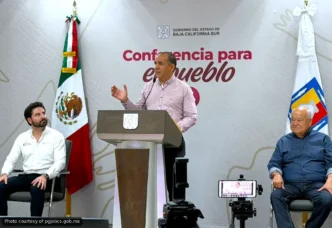
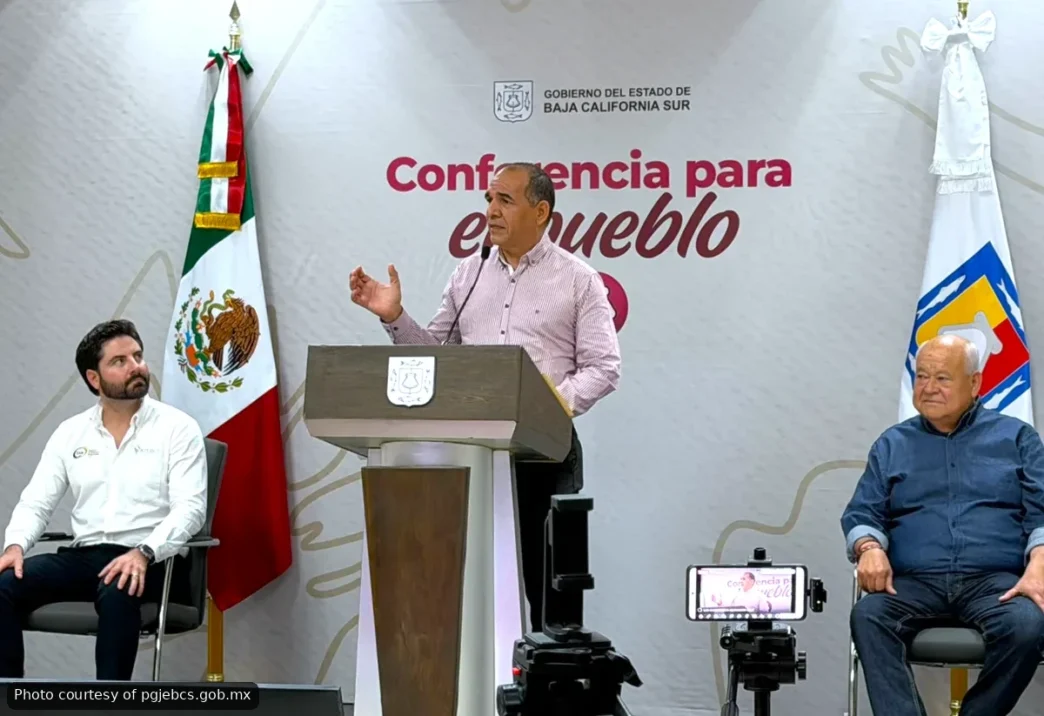
Baja California Sur’s top prosecutor publicly rejected accusations from national politician Ricardo Anaya, who claimed the state is concealing the true number of homicides by misclassifying them in official crime statistics.
During this week’s state press conference, State Attorney Antonio López Rodríguez called the allegations “completely false” and explained that Anaya had misinterpreted how federal crime data is categorized.
Anaya, a senator from the National Action Party (PAN) and former presidential candidate, told Mexico’s Senate that Baja California Sur hides six out of every seven homicides by reclassifying them under a statistical category called “other crimes against life and physical integrity.”
What Anaya Claimed
According to Anaya’s interpretation of data from the National Public Security System’s executive secretariat, BCS reported only 39 intentional homicides from January through August. But the same database listed 172 incidents under the “other crimes” category — which Anaya argued should be counted as murders.
“We have reported 39 homicides so far this year,” López Rodríguez said. “But according to the senator, we are hiding six times that many — around 273 total homicides. That is completely false.”
The prosecutor explained that the “other crimes” category includes offenses that are not homicides: negligent care, failure to render aid, attempted homicide, medical negligence and obstetric violence. These are separate criminal classifications under Mexican law and are reported as such to federal authorities.
Governor Responds
Governor Víctor Castro Cosío, who appeared alongside the prosecutor, defended the state’s transparency and accused Anaya of making claims without understanding the region. “We are not covering for anyone, but we also will not allow people who don’t even know our state to spread false information about manipulated numbers,” Castro said.
The governor also pointed to past PAN administrations in BCS, questioning their own record on security and accusing them of dismissing officials who raised concerns about disappearances.
The dispute comes amid broader national debate over how Mexico counts violent deaths. Anaya has argued that federal crime statistics underreport the true scale of violence by reclassifying homicides into adjacent categories. BCS officials have recently faced other accusations, including AI-generated misinformation targeting journalists and lawmakers.
What the Data Shows
López Rodríguez said BCS reported 39 intentional homicides from January through August, and that all 172 cases in the “other crimes” category were properly classified according to the federal penal code. He added that the state’s figures are verified by multiple law enforcement agencies that participate in the State Security Board.
“There is no interest in lying to the public,” the prosecutor said. He emphasized that BCS maintains regular coordination with federal authorities and that crime data is cross-checked by state, municipal and federal agencies.
For foreign residents and visitors, the controversy highlights ongoing questions about how crime is measured and reported in Mexico. While Los Cabos has worked to counter false reports about safety conditions, differing interpretations of federal data can create confusion about the actual security situation in the state.
What It Means for Residents
The exchange between Anaya and BCS officials does not change day-to-day security conditions, but it reflects the broader political debate over transparency and crime reporting in Mexico. Residents should continue to rely on local reports from municipal and state authorities, and consult official advisories from consulates when assessing safety.
BCS remains one of Mexico’s safest states by most metrics, though disputes over how crimes are categorized can make it difficult to compare official statistics across regions or over time.
