

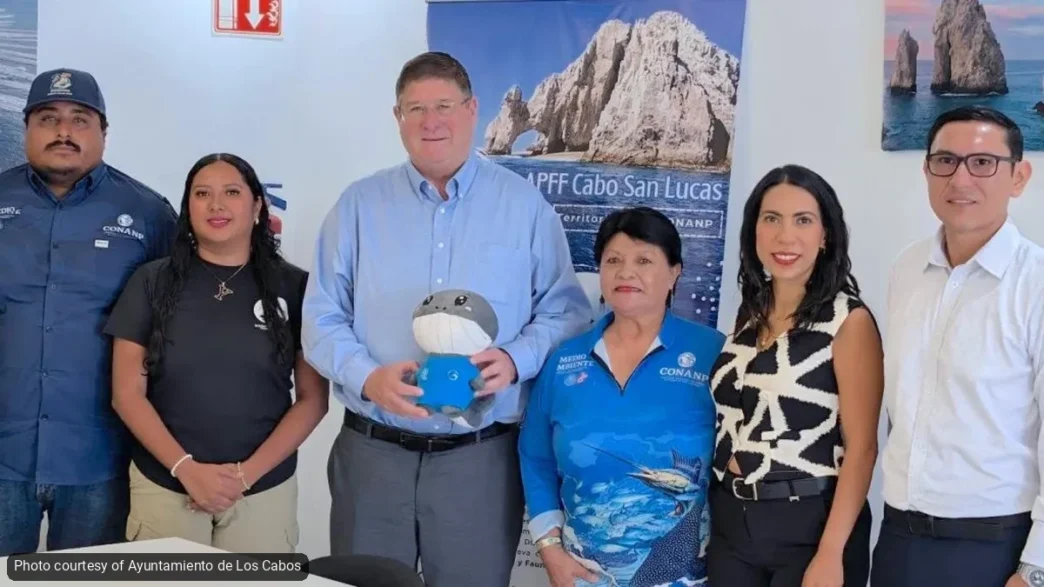
The US Consul General in Tijuana does not drop by Los Cabos very often, which is understandable given that his jurisdiction covers two states and a very long highway. But this week Lance Hegerle made the trip south, and his visit doubled as a quiet reminder of something many American residents and visitors never think about until they need it: who exactly handles their passport problem, lost wallet or worse, roughly 1,600 kilometers (about 1,000 miles) from the nearest US consulate.
Hegerle’s itinerary, as described in a statement from the municipality of Los Cabos, started with a walking tour of San José del Cabo’s historic center. He was accompanied by municipal Tourism Director Ana Gabriela Navarro González, Administration Director Verónica Olvera Guevara, Sister Cities coordinator Carlos González Amador and municipal chronicler Jorge Aníbal Amador Castro, who walked the group through the backstory of the Palacio Municipal, Plaza José Antonio Mijares and the San José parish church. It was, in diplomatic terms, the equivalent of a proper welcome.
The more practical stop came afterward, at the Centro de Atención al Turista (CATAC) in Cabo San Lucas, the municipal tourist-assistance office. There, local officials briefed the consul on how the Tourism Department handles visitor orientation, complaints and emergency referrals, and how that work gets coordinated with other agencies. It is the kind of meeting that rarely makes headlines, but it is also the mechanism that decides how quickly a problem gets escalated when a tourist or resident needs more than a map and a shrug.
Why This Matters When You’re Hours From the Nearest Consulate
Here is the part that tends to surprise newer arrivals: there is no full US consulate in Los Cabos or anywhere in Baja California Sur, only a US Consular Agency in San José del Cabo that handles routine services and emergency referrals. The full consulate covering the entire peninsula sits almost a thousand miles north in Tijuana, and for the most serious cases, an arrest, a hospitalization or a death abroad, families may still end up coordinating with that office by phone.
In practice, Americans in Baja California Sur can start with the US Department of State’s emergency line for citizens abroad or the Tijuana consulate directly, rather than assuming help is a short drive away. Routine passport renewals can often be handled by mail through the State Department’s standard process, but emergency replacements and arrest or hospitalization cases typically require direct contact with consular staff. Knowing that ahead of time, rather than discovering it mid-crisis, is the entire point of these kinds of institutional visits.
This was not the first time a consular visit has produced goodwill rather than headlines. In past years, the US Embassy has delivered formal recognition to the Los Cabos government for cooperation on tourist safety, suggesting these relationships get maintained with some regularity, even if most residents never hear about them.
City officials framed Hegerle’s visit as part of ongoing coordination with diplomatic missions whose jurisdiction includes both Baja states, with Mayor Christian Agúndez Gómez’s administration describing it as an effort to keep communication channels open with consular representatives. Nothing about the visit changes services overnight. But for anyone planning an extended stay in Los Cabos, it is a useful nudge to save the Tijuana consulate’s contact information before it is needed, not after.