


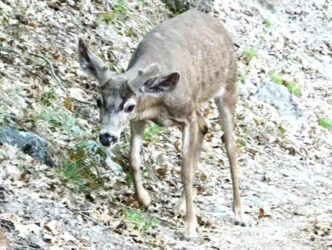

A conservation project proposed for Los Cabos would set up an Environmental Management Unit (UMA) dedicated to protecting the Southern Baja California mule deer, with an estimated investment of 100 million pesos (about $5.7 million USD).
The initiative, planned for San José del Cabo, is seeking federal environmental authorization to develop the Wildlife Management Unit on a 900,000-square-meter property in the community of La Palma.
Known as UMA CEICA (Center for Education, Research, and Environmental Conservation), the project is being promoted by the Hermandad en Armonía association. The mule deer is native to western North America and is recognized for its large, mule-like ears, distinctive white rump patch, and narrow tail with a black tip.
Project Plans and Infrastructure
According to the Environmental Impact Statement (EIS), the project aims to establish a center dedicated to mule deer reproduction, research, environmental education, and conservation. Plans include the construction of four buildings, access roads, multipurpose areas, parking facilities, a water supply system, electrical infrastructure, and a wastewater treatment plant.
The proposal would require changing the land use designation of 45,949.55 square meters from forest to urban use, representing about 5.1 percent of the property’s total area.
Environmental Damage and Regularization
One of the most significant aspects of the proposal is its acknowledgment of earlier environmental damage. The Environmental Impact Statement states that 10,968 square meters of land were cleared in an area originally covered by tropical deciduous forest. The document acknowledges that the clearing “was carried out without the corresponding permits,” prompting the applicant to begin a regularization process with the Federal Attorney’s Office for Environmental Protection (PROFEPA), under file number PFPA/10.2/3S.2/0024-26.
Environmental studies included in the assessment show that the proposed site contains significant ecological resources. Researchers identified 40 plant species within the Regional Environmental System and 26 species within the project area. Among them are the San José barrel cactus, listed as a threatened species, and the garambullo cactus, which is under special protection.
The study also reports a Margalef Index greater than 5.0, an indicator of high biological diversity that, according to the assessment, formally classifies the area as a high-biodiversity ecosystem.
Although the property is not located within a federally protected natural area, it lies within the San José del Cabo Basin and Estuary Riparian System Ramsar Site and the Sierra La Laguna Important Bird Area, giving the project additional environmental significance. The Environmental Impact Statement concludes that the proposal is consistent with existing ecological land-use planning and would support wildlife conservation through rescue, relocation, and monitoring programs.
Environmental Impact Assessment and Mitigation
The environmental assessment found 278 interactions between the project and the surrounding environment. Of those, 154 were classified as positive and 124 as negative. The analysis found 96 compatible impacts, 27 moderate impacts, and one severe impact, primarily associated with vegetation clearing.
Potential environmental risks include the loss of vegetation cover, soil erosion, dust and noise emissions, and habitat disturbance for wildlife.
To address those impacts, the project proposes more than 20 mitigation measures, including flora and fauna rescue programs, forest restoration, invasive species control, environmental education, and integrated waste management.
The project’s future now depends on SEMARNAT’s evaluation of the proposed land-use change and whether the mitigation measures are sufficient to offset the expected environmental impacts.