


Scientific collections remain scattered while the need grows to protect a fossil heritage that helps reconstruct the evolution of marine life in the North Pacific.
The Autonomous University of Baja California Sur (UABCS) became a focal point for discussions on science, natural history and public awareness during the 3rd Permanent Panorama Forum, The Paleontological Heritage of Baja California Sur. The event also highlighted the urgent need to establish a natural history museum to preserve the region’s extraordinary fossil legacy. Held in the Reading Room of the university’s Central Library, the forum brought together specialists from the Department of Marine and Coastal Sciences, who presented research that positions Baja California Sur as one of the most important regions for studying the evolution of marine life in the North Pacific.
The panel featured Drs. Citlali Solís and Gerardo González, marine biologist Natalia Rangel, and was moderated by Dr. Mehdi Mesmoudi of the Department of Humanities. The speakers agreed that southern Baja California preserves a geological archive dating back millions of years.
Million-Year Archive Beneath BCS Soil
During her presentation, Solís explained that the fossil record of Baja California Sur documents a remarkable biological diversity, allowing scientists to reconstruct marine ecosystems from the Cenozoic Era, approximately 55 million years ago, through more recent geological periods.
Solís said research conducted in the state has led to the identification of new fossil cetacean species, underscoring the scientific importance of the peninsula’s geological formations. “I have worked mainly with cetaceans, and new species have emerged. This indicates that there is great diversity in these deposits on the peninsula,” Solís said.
In addition to primitive whales, the state’s paleontological sites contain fossils of sea turtles, sharks, dolphins, dugongs and sperm whales, as well as terrestrial megafauna such as horses and camels. Together, these remains allow researchers to reconstruct evolutionary changes spanning millions of years.
Solís emphasized that studying and formally describing these fossils is essential because many specimens remain unanalyzed and unpublished, representing significant opportunities for future scientific research.
Extinct Marine Mammals Found Nowhere Else
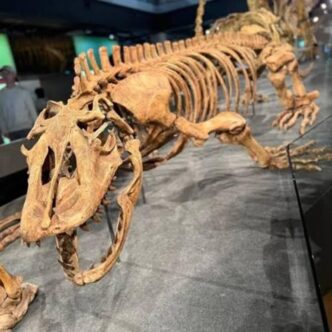
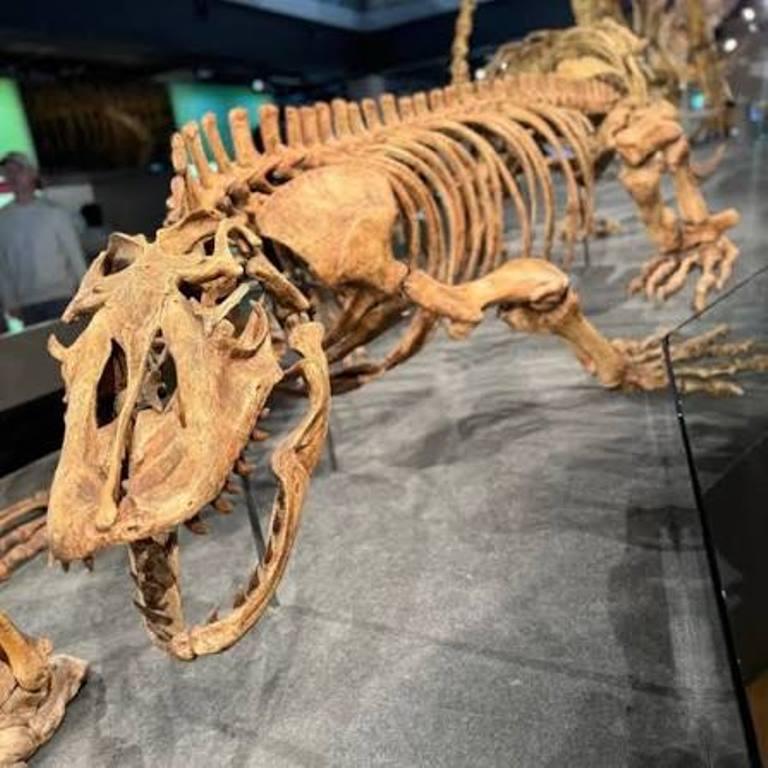
Marine biologist Natalia Rangel focused her presentation on desmostylians, an entirely extinct order of marine mammals whose fossil record in Baja California Sur is internationally significant. Unlike cetaceans and sirenians, which still have living representatives, desmostylians disappeared completely, making each fossil discovery especially valuable.
“It is the only order of marine mammals that is completely extinct. In Mexico, BCS is the only place where fossils of this group have been found,” Rangel said.
She added that desmostylian fossils have only been discovered in regions bordering the North Pacific, from Japan to Baja California Sur, making the state the southernmost location in the world where their presence has been documented.
The discovery places BCS among the most important regions for understanding the evolution and geographic distribution of extinct marine mammals.
Thousands of Specimens Need Proper Preservation
Gerardo González, curator of the UABCS Natural History Museum’s paleontological collection, said the university houses thousands of fossil specimens recovered from sites including San Juan de la Costa, La Purísima, Santa Rosalía and the San José del Cabo Basin.
He said the collections represent scientific and cultural heritage of enormous value but lack an adequate facility for long-term conservation and public exhibition. “We have several thousand pieces. We want a suitable space where this heritage can be shared with the university community, local residents and visitors,” González said.
He noted that many of the collections are currently dispersed among research laboratories, hallways and storage areas, limiting both public access and proper preservation. “We need a museum. We need a dignified space for these collections,” he said.
Museum Project Advances with Institutional Support
González added that collaborations with other institutions and organizations are already underway to advance the creation of a natural history museum, a project he described as essential to protecting the region’s paleontological heritage.
The forum also highlighted strong public interest in learning more about the region’s fossil record. According to the panelists, that interest presents an opportunity to strengthen science education and increase public awareness about protecting natural heritage.
González said scientific outreach is essential for encouraging community involvement in preserving this legacy, emphasizing that paleontological heritage belongs not only to the scientific community but also to the people and history of Baja California Sur.
Building Scientific Culture Through Education
The forum concluded with a call to strengthen research, conservation and public outreach efforts to build a stronger scientific culture and ensure the preservation of the region’s fossil heritage.
“We hope this forum has sparked interest in the world of paleontology and that everyone leaves with greater curiosity to learn more,” Mesmoudi said.
The event was part of a series of seminars commemorating the 50th anniversary of UABCS, reinforcing the university’s role as a center for scientific research, education and preservation in Baja California Sur.
The central message was clear. Beneath the soil of Baja California Sur lies a natural archive millions of years old, and its preservation depends on the decisions made today.