

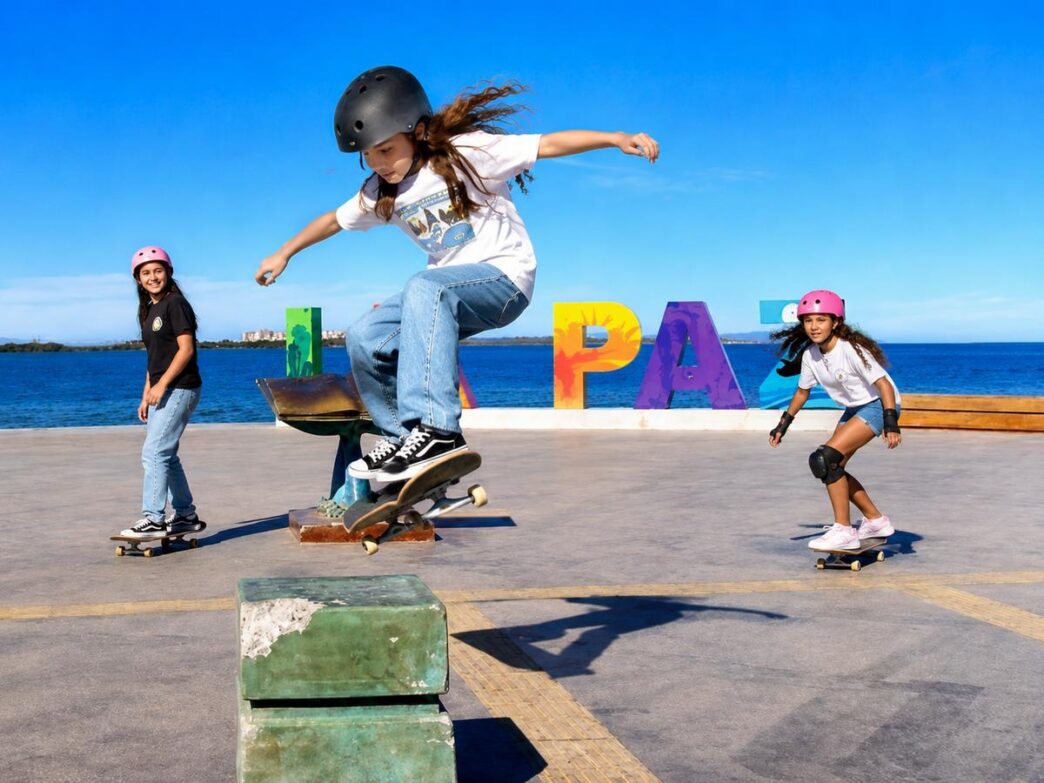
Official competitions have opened a new chapter for skateboarding in Baja California Sur. A discipline that for years was primarily a recreational activity is now part of organized sports programs that include state qualifiers, selection events and participation in national competitions linked to the CONADE National Games.
Coaches and participants report a growing number of young people joining the sport, particularly since skateboarding was incorporated into competitive championships. Activities take place at venues across La Paz and Los Cabos, where free practice sessions are complemented by training programs focused on athletic development and competition.
Building the Next Generation of Athletes
Among those helping shape the next generation of athletes is Brayan Vega, coach of the Baja California Sur skateboarding team and director of The 612 Skate Club, which offers classes for people of all ages and skill levels. The club’s name references La Paz’s area code.
“I have a sports club where I work with boys and girls, and, when the opportunity arises, adults,” Vega said. “We do not make distinctions based on age or gender. Right now, I’m training the athletes from the state team, who recently competed at the CONADE National Games.”
Vega said skateboarding was incorporated into competitions linked to the National Games about six years ago, becoming part of a sports program historically dominated by disciplines such as soccer, taekwondo and swimming.
How Competition Structure Works
According to Vega, the competitive process begins with a state tournament, where athletes qualify for the team that will represent Baja California Sur.
“First, a state tournament is held, and from there the state team is selected,” Vega said. “Then comes a national inter-association competition, where each state participates with its full team, and only the top athletes in each category advance.”
Competition is primarily divided into two disciplines: park and street. Park events take place on courses featuring ramps, transitions, curves and elevated structures, including bowls that resemble empty swimming pools used for runs and tricks. Street events focus on obstacles that simulate urban elements such as stairs, handrails, rails and platforms, where athletes perform technical tricks.
The competition structure also includes separate divisions for male and female athletes, as well as age categories. These include Junior Youth for participants ages 10 to 13, Senior Youth for those ages 14 to 17, and the Open category for athletes 18 and older, although younger competitors may also participate.
The Mexican Federation of Roller Sports (FEMEPAR) then selects a national team from the highest-ranked athletes in each discipline and category to compete in the corresponding stage of the CONADE National Games.
Recent Tournament Results
The most recent tournament cycle brought six athletes from Baja California Sur to Guadalajara, where they competed May 14 – 15 as part of the national competition.
“This time we took a group of six boys and girls,” Vega said. “We didn’t win any medals, but they performed very well. Four competitors finished in the top eight.”
The largest delegation sent consisted of 11 athletes. Vega noted that Baja California Sur first joined the national competitive process in 2022.
Changing Perceptions of the Sport
The growing presence of young athletes represents one of the most significant changes for longtime participants.
“There used to be no children in skateboarding, and even fewer girls,” Vega said. “When the CONADE competitions and travel opportunities started, many kids became motivated, and so did their parents. Little by little, the perception of the sport changed.”
That growth has been concentrated primarily in youth and junior divisions. Participation among girls has also increased, although Vega said the outlook differs for older generations of skaters.
“Skateboarding here has its ups and downs,” he said. “On the youth side it has grown, but among adult skaters it has slowed down somewhat. I think what keeps it alive is the city’s support for the skate scene.”
He added that greater support is needed for veteran skaters, who often serve as role models for younger athletes.
Standout Athletes Shaping the Scene
Vega moved to Baja California Sur when he was 3 years old and began skateboarding at age 9. Now 26, he remains actively involved in the sport’s development.
Among the state’s most recognized skateboarders is Tlaloc Tenoch of Los Cabos, who previously gained attention for his success at national championships. Vega also highlighted Guillermo Martínez and Noé Castro as standout local talents.
Sara Elena, one of the few young female athletes training under Vega, said she began skateboarding at age 7.
“I love everything about skateboarding,” she said. “I prefer the street discipline. It’s a sport where you can fall, but it teaches you something: if you fall, you must get back up, and that lesson applies to everyday life.”
Another promising athlete, Briana Aragón, said she began skateboarding at age 12 and now competes in both street and bowl disciplines.
“What I would tell children who want to skate is that they need to put in the effort,” Aragón said. “If they don’t give up, they can go very far, and that applies to any sport.”
Skateparks in La Paz and Los Cabos
In La Paz, key skateboarding venues include Camino Real Skate Park, located on Calzada Camino Real between Beige and Amarilla streets, and Cuauhtémoc Park on the Álvaro Obregón waterfront promenade between Nicolás Bravo and Mutualismo streets.
In Cabo San Lucas, skateboarders have access to the CODEPA Skatepark, the bowls of El Pescadero, and both the Guaymitas Bowl and the 5 de Febrero Skatepark in San José del Cabo.
“We offer free classes in the afternoons at Camino Real Park and at DIF Loma Linda,” Vega said. “We work with everyone from beginners to advanced skaters.”
From Surfing Roots to Modern Competition
Skateboarding originated on the U.S. West Coast in the mid-20th century when surfers sought ways to practice outside the ocean. Over time, it evolved into modern park and street disciplines, incorporating ramps, empty swimming pools and other structures that helped define the sport.
What began as an offshoot of surfing has since become part of international competition and official sports programs in Mexico. In Baja California Sur, as new generations fill skateparks and ramps, the challenge now is sustaining a community that balances recreation, athletic development and competition.