



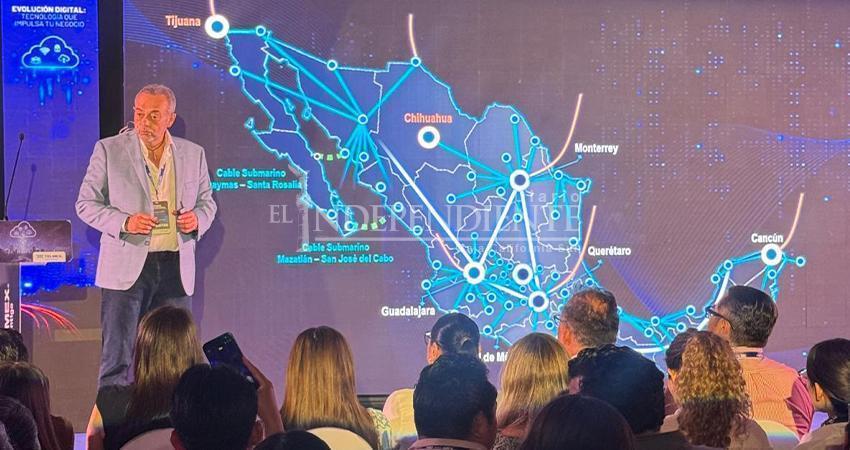
Baja California Sur has become the first state in Mexico to complete the transition from legacy telecommunications systems to modern fiber-optic technologies, a milestone that is now being extended to strategic sectors such as the hospitality industry.
Speaking at the Digital Evolution event in Los Cabos, Valerio Torre, Director of Technological Development, said the state has served as a testing ground for new technology strategies due to the unique challenges posed by its geographic location.
“For the past year, Baja California Sur has been the first state in the country to fully retire digital telephony, TDM services, and SDH-based network transport systems,” Torre said. “Today, it is a modernized state supported by fiber-optic, IP, and Ethernet technologies.”
Submarine Infrastructure Strengthens Connectivity
Torre noted that one of the state’s greatest connectivity challenges has been its geographic isolation and the vulnerability of communications during hurricane season. Historically, Baja California Sur has depended on a limited number of connections to maintain communication with the rest of the country.
To address those challenges, new submarine telecommunications infrastructure has been deployed in recent months. Among the key projects is the TMX5 system, a 383-kilometer submarine cable installed at depths of up to 3,126 meters. The cable connects San José del Cabo with Mazatlán and Santa Rosalía with Guaymas.
According to the company, the project was designed to strengthen the security and resilience of telecommunications services in the state by reducing the risk of outages caused by severe weather or disruptions along existing routes.
“Today, we believe Baja California Sur has complete coverage and sufficient redundancy to ensure the continuity of telecommunications services,” Torre said.
Expansion Into Hospitality and Data Centers
The next phase of the initiative will focus on expanding access to these technological capabilities within the hotel sector, particularly in Los Cabos, where reliable connectivity has become an increasingly important factor in both business competitiveness and the visitor experience.
Torre also announced that construction of two new data centers is scheduled to begin this year. The facilities are expected to increase data processing and storage capacity to meet growing digital demand across multiple industries.
The investment in telecommunications infrastructure comes as businesses increasingly rely on digital tools, cloud-based services, and high-speed connectivity to improve operations and deliver more efficient services to customers.