


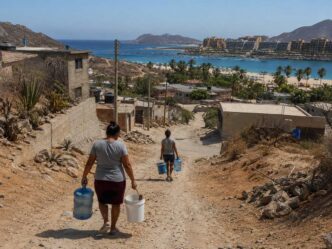

The lack of drinking water remains one of the most serious problems facing hundreds of families in Cabo San Lucas, where residents say water service is unreliable and, in some cases, arrives only once a month.
As temperatures rise during the hottest months of the year, many residents are being forced to purchase multiple storage tanks and pay for costly water truck deliveries to cope with prolonged shortages. Some families report spending as much as 3,000 pesos ($173 USD) per delivery.
Uriel Monroy, a resident of the La Joya neighborhood, said the shortage has created added financial burdens for apartment residents, who must pay both water bills and maintenance fees tied to water access.
“We practically only have water once a month, if we’re lucky,” Monroy said. “In my case, the apartment maintenance fee covers part of the drinking water bill, so we end up paying twice.”
The situation reflects broader infrastructure challenges in Baja California Sur, which ranks among the lowest nationally in access to reliable garbage collection and drinking water services. Residents say many families are forced to ration water for weeks to meet basic household needs. Purchasing storage tanks and relying on private water deliveries has become part of daily life due to service failures and delays.
In neighborhoods such as Caribe Bajo, residents say buying water is now a permanent household expense. Catalina Pérez said her family of five spends approximately 3,000 pesos per month on water, equivalent to two truck deliveries at 1,500 pesos ($85 USD) each.
“We don’t have running water, so we have to buy water all the time,” Pérez said. “It has become a fixed monthly expense.”
Felipe Reyes, a resident of Arcos del Sol, said he invested in several additional water tanks because of the inconsistent service.
“Water arrives every month and a half, or if we’re lucky, every 20 days,” Reyes said. “If you don’t have a cistern or several water tanks, you won’t survive, especially during the hot season.”
Residents say dependence on water trucks has become a necessity throughout Cabo San Lucas.
Alejandra Monroy said many families are forced to pay both municipal water bills and private delivery services, with some truckloads now costing more than 2,000 pesos ($115 USD).
“We pay the bill even though we don’t have consistent service, and on top of that we still have to pay for water deliveries,” she said.
As temperatures continue to climb across the region, residents from multiple neighborhoods say improving water access and ensuring a more reliable municipal supply has become urgent.
The crisis affects not only working-class families but also some American and Canadian expatriates living in gated communities, many of whom rely on water truck deliveries at least twice a month.
Critics argue that the issue is not a lack of water availability, pointing to the large number of trucks distributing water daily throughout Los Cabos. They contend the problem lies in how water is managed and distributed at the municipal level.
While luxury resorts, golf courses, and affluent communities generally maintain stable and independent water supplies, many working-class neighborhoods continue to struggle with chronic shortages.