


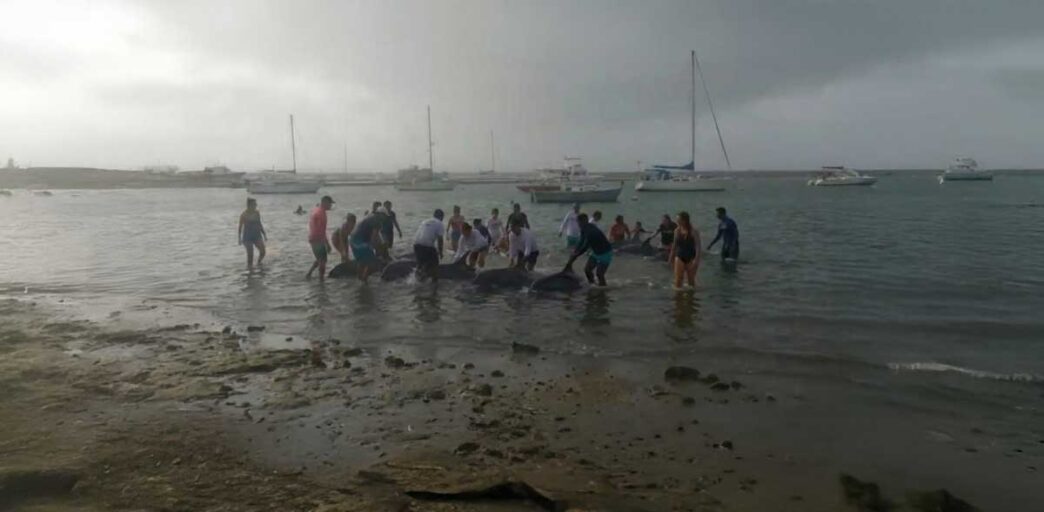
On New Years’ Day, locals and tourists in La Paz watched something unforgettable and worrying: about ten dolphins stranded near the Malecon, between Allende and Rosales. People jumped into the water, helping these sleek marine mammals swim back to deeper waters — instincts kicking in for these iconic ocean neighbors.
At first glance, it looked like low tide was the culprit — a theory many in the area echoed. But dolphin strandings are rarely that simple. Scientists say that animals winding up on beaches can have many causes, and often they’re a sign of a bigger ocean health issue.
Why Dolphins Strand: The Big Picture
Dolphin strandings — whether single animals or groups — happen all over the world. Marine experts haven’t pinned down one cause, but here’s what we do know:
🔹 Natural Causes
Just like people, dolphins get sick. Illnesses, old age, injuries, or trouble navigating (especially in shallow or gently sloping coastal areas) can make them lose their way. Their echolocation sometimes fails near soft beaches, and they get stuck.
🔹 Strong Social Bonds
Dolphins are super social animals. If one member of a pod gets into trouble, others may follow — even into danger. This “follow-me” behavior might explain group strandings like the one in La Paz.
🔹 Human Impacts
Human activity plays a significant role in why cetaceans beach themselves. Noise from boats, pollution, and fishing gear can disrupt their communication and navigation — even cause physical harm. Climate change also alters sea conditions, shifting food supplies and habitats.
In the Bay of La Paz, marine mammals have been stranding for over a century — researchers counted hundreds of events going back to the early 1900s. Certain coastal shapes, shallow waters, and currents in this bay seem to create “natural traps” where animals get stuck more easily.
What You Should Do If You Spot a Stranded Dolphin
When the dolphins were at the Malecon, people’s instincts kicked in and they waded in to help. That’s a powerful moment — but experts say there’s a right way and a risky way to help stranded marine mammals:
✔ Do This:
🌊 Call trained responders — local marine mammal rescue teams, wildlife authorities, or environmental organisations.
📞 Alert someone immediately so professionals can arrive fast.
❌ Don’t Do This:
🚫 Don’t push or pull dolphins back into the water yourself — without proper training, you might injure them worse.
🚫 Don’t pour water on them or try to lift them — dolphins are heavy, fragile, and need careful handling.
🚫 Don’t crowd them — stress makes their situation worse.
Live strandings aren’t just about getting the animal to deeper water — stranded dolphins often need medical care to recover before they can survive on their own.
Why It Matters
Seeing dolphins up close is magical — and concerning. But strandings remind us that our oceans are under pressure. Whether it’s changes in tides, coastal geography, or human impacts like noise and pollution, our actions matter. A dolphin beaching is nature’s alarm bell. 🌊❤️
If we want to keep the waters of the Gulf of California thriving — for dolphins, whales, and future generations — we all need to watch, report, and protect.

What happened to the Dolphins? Are they ok ?
Yes, ALL the dolphins survived. There were close to 50 dolphins that afternoon/eve, including many young animals. We monitored the entire bay the following bay to make sure none of the animals restranded.
http://www.mmwrc.org
Including the actual number to call for the response team would have been helpful.
Right!? 😉
You can report directly to us re****@***rc.org or re*****@***rc.org
Both english and spanish spoken
or to PROFEPA if your spanish is adequate
Hola, this is Mexico Marine Wildlife Rescue Center. Thank you for your article. We’ll clear up a few facts. There were actually nearly 50 dolphins that stranded, including many young animals. They were long-beaked common dolphins (Delphinus delphis). ALL of the dolphins did survive the mass live stranding event. The public in this instance was very helpful but we do agree that training is important because there is a right and a wrong way to do things and people and animals can both get hurt if the wrong actions are taken. We understand the emotional response and urge to help and we are so grateful to everyone who participated on January 1st! We herded the dolphins out of the bay that evening and prevented them restranding at Costa Baja. The next day we monitored for 6 hours and found no stranded dolphins (live or dead) which was a fantastic outcome. To learn more or get involved, folks can contact us at in**@***rc.org and visit our website http://www.mmwrc.org
We are a Mexican non-profit, run by volunteers and operated only on donations. We are based here in La Paz but we work throughout Baja and the rest of Mexico to rescue and protect marine wildlife. Our work includes rehabilitation and reintroduction of sick and injured marine wildlife.
Please report any strandings directly to us re****@***rc.org or PROFEPA in your area. English and Spanish spoken. Muchisimas gracias!