


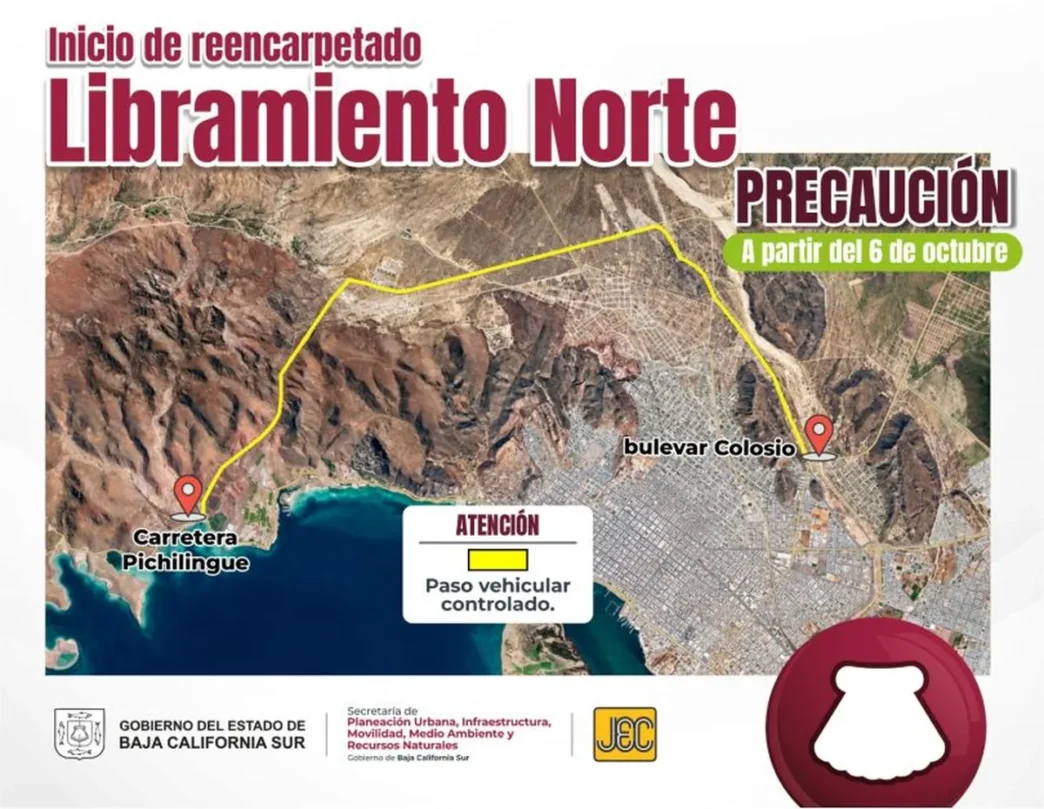
If your route into or out of La Paz runs along the Libramiento Norte, budget a few extra minutes starting this week. Crews with the state highway agency, Junta Estatal de Caminos (JEC, Baja California Sur’s state road authority), began rehabilitation work on October 6 along the bypass, with a 10 million peso budget — roughly $550,000 USD — attached to the project.
The work zone runs from the junction with the Pichilingue highway out to the intersection with Boulevard Colosio, a stretch that handles a steady mix of commuter traffic, cruise and ferry-bound vehicles, and trucks heading to and from the port. That makes it one of the busier arteries on La Paz’s north side, which is exactly why the state decided it needed attention rather than another round of patchwork fixes.
What the Crews Are Actually Doing
This isn’t a quick pothole patch. According to JEC director Jorge Alberto Cota Pérez, the project involves stripping and recovering the existing asphalt surface, treating and compacting the base layer underneath, and then laying fresh hot asphalt on top. Crews will also handle standard bacheo (pothole repair) and repaint the lane markings once the new surface is down — the kind of ground-up resurfacing that, done properly, should outlast the usual seasonal fill-and-forget approach.
It’s the latest entry in a string of road projects across the state this year, following work on the La Paz–Pichilingue road section and separate pothole repairs on the Transpeninsular Highway. In Baja, a road project rarely arrives alone — it’s usually one piece of a broader effort to catch up on maintenance that summer rains and years of heavy use tend to expose all at once.
The Detour, in Practical Terms
Here’s what actually changes on the ground: traffic will not be shut down, but it will be squeezed. Only one lane will stay open through the work zone, with flaggers directing alternating passage in each direction — meaning you’ll stop, wait, and go, rather than cruise straight through. JEC is asking drivers to stick to posted speed limits and actually follow the personnel on site, which is less a suggestion than a necessity given the narrowed lane and the equipment working close to traffic.
If you use this corridor daily — for the ferry terminal, for work, for school runs — plan on slower mornings for as long as the single-lane restriction remains in place, rather than a single bad day. Mexican road projects of this scope typically run anywhere from three weeks to a couple of months depending on weather and materials delivery, though the state has not published a firm completion date. Anyone who’s dealt with previous detour projects around the city knows the drill: alternate routes exist, but they add time, so the real move is just leaving earlier.
State officials framed the project as part of a broader commitment to keep BCS highways in better shape and, in their words, provide safer and longer-lasting roads for residents of the state. Whether that promise holds up a year or two down the line is the usual open question with infrastructure work here — but for now, the practical advice is simple: expect one lane, expect a wait, and give yourself a buffer if your route runs through Libramiento Norte toward Pichilingue.