


If your car has developed a new rattle somewhere between the stoplight and the supermarket, you are not imagining it. Summer and early fall rains chewed through pavement across Baja California Sur, and two municipalities are now in the middle of parallel pothole campaigns worth knowing about if you drive through La Paz or Cabo San Lucas regularly.
In La Paz, the Programa Emergente de Bacheo — an emergency pothole-repair program the city rolled out to handle the backlog — has filled 8,662 potholes between July and October, according to figures released by the municipal government and reported by BCS Noticias. The city says it has also purchased 60 additional tons of asphalt to keep pace with resident complaints, and crews have leveled or rehabilitated more than 93 kilometers (about 58 miles) of streets and roads in the process. That is not a small side project; that is most of a small city’s road network getting touched in a single season.
The push has been especially visible over the past week. Between October 14 and 17, brigades worked 12 separate points around the city, including Avenida Universitaria between Boulevard Forjadores and Camino Vecinal, Avenida Tecnológico, stretches of Benito Juárez and Colegio Militar, Avenida Revolución between 5 de Mayo and Morelos, and sections of Avenida de los Deportistas, Marcelo Rubio, Luis Donaldo Colosio and the area around Parque Lineal. From October 19 through 23, crews are scheduled to move on to Boulevard Forjadores, the Canalecón drainage zone, and the Santa Bárbara, San Fernando, Santa Rosa, Camino Vecinal and Bahía de La Paz corridors. The city also says it is adding an extra brigade dedicated to the downtown Centro area, with no plans to pause the work.
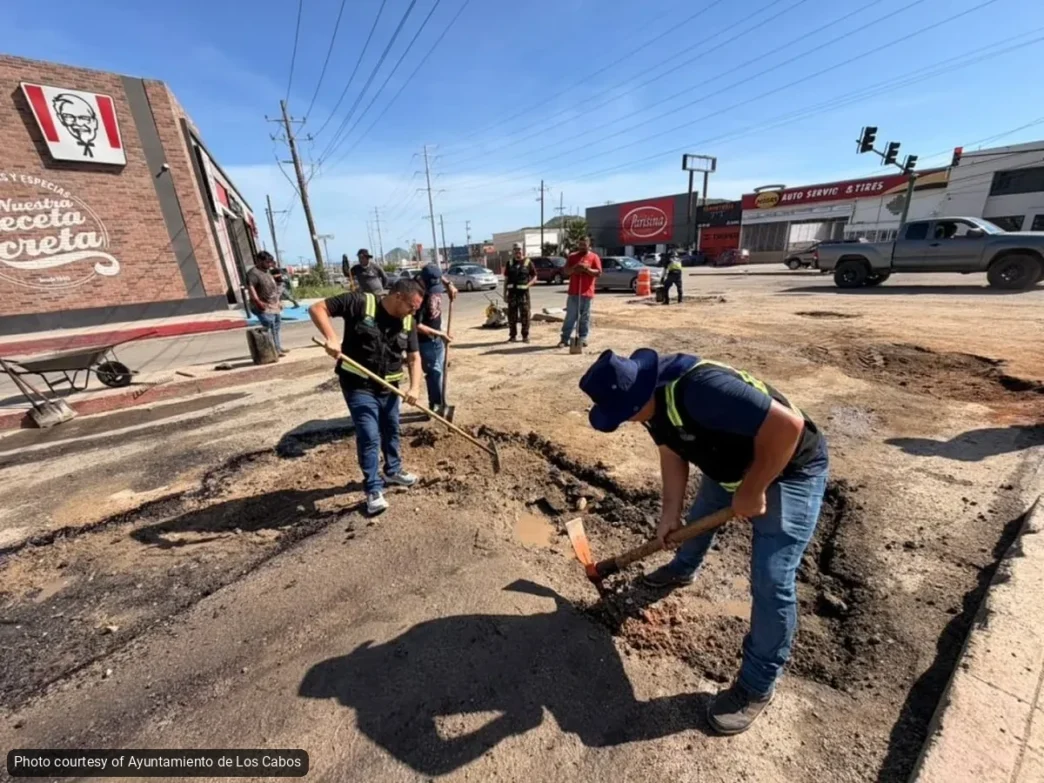
Cabo San Lucas is running its own version of the same story, though on a smaller, more continuous scale. The XV Ayuntamiento de Los Cabos (the current city administration) says it has kept pothole crews moving through the fall using hot asphalt rather than the cold-patch mix that tends to wash out again at the first good rain. Work this week has focused on Calle Los Aguajitos, under the direction of Mayor Christian Agúndez Gómez and the city’s public works and human settlements department, led by Christopher Enríquez González, according to a statement from the Los Cabos municipal government. Officials describe it as an ongoing maintenance effort rather than a one-time emergency response, which tracks with local reporting that has tracked the crews bouncing between neighborhoods for months, including an earlier shift to nighttime repair schedules meant to cut down on daytime traffic headaches.
None of this means every street is suddenly smooth. Pothole programs in Baja tend to work like whack-a-mole: close one gap in the pavement and the rain finds another a few blocks over. But the scale of the La Paz numbers, and the fact that Cabo San Lucas is sticking with hot asphalt instead of a quick cosmetic fix, suggests both cities are treating this as an actual maintenance cycle rather than a photo-op patch job before the holidays.
If a chronic pothole on your own street hasn’t made the list yet, both municipalities take citizen reports, and knowing how to report a Los Cabos pothole and what actually happens after you do is worth five minutes before you assume nobody’s listening. For now, expect lane shifts and slow zones on the streets named above through the rest of October, and drive the usual back roads with a little extra caution until the crews finish their pass.