


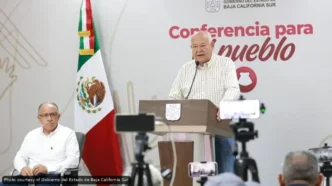
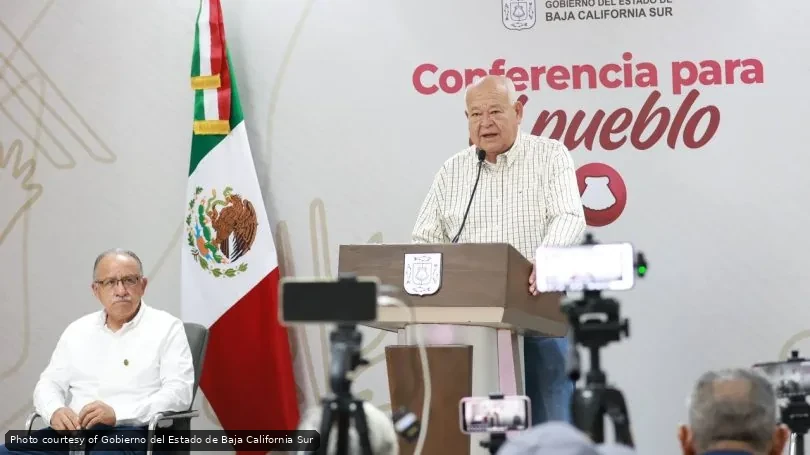
Baja California Sur Governor Víctor Castro triggered a political firestorm this week after suggesting that Mexico should consider expropriating private businesses — including banks, airlines and shipping companies — and returning them to state control.
The comments, made during a public event, drew immediate condemnation from opposition lawmakers and even some members of his own Morena party. Critics warn the proposal could damage investor confidence at a time when the state is actively navigating water-supply challenges and trying to attract capital for infrastructure.
“It seems very important to me, not just with shipping companies, but that we start taking back everything that was privatized,” Castro said, according to ADN40. “Little by little, the banks could become national again, the railroads could return to being national — as we are already achieving — and we could bring back aviation, as we are doing with Mexicana de Aviación.”
He argued that state ownership would lead to cheaper fares, better freight rates and stronger protections for communities.
Federal Deputies Push Back
Rubén Moreira, coordinator of the PRI caucus in the Chamber of Deputies, called the remarks “very concerning” and said they reflect “disdain for property and for private enterprise.” He warned that expropriating industries would deal a devastating blow to the national economy and noted that similar experiments have already failed in Mexico’s past.
“Who is going to want to come to Mexico when the governor of an important state like Baja California Sur, a Morena member, is saying these things?” Moreira asked, according to MVS Noticias.
He also pointed out that Castro is widely seen as close to former President Andrés Manuel López Obrador, raising the possibility that the comments reflect a broader ideological current within the ruling party — or at least a trial balloon to test public reaction.
Even within Morena, the idea drew skepticism. Ricardo Monreal, the party’s congressional leader, said he does not support nationalizing the banking sector. “That is something we already went through. There was a time when we experimented with that, and it did not go well for us,” he told reporters.
Echoes of 1982
Castro’s remarks immediately evoked comparisons to José López Portillo’s 1982 bank nationalization, a move that saddled the government with enormous debt, led to capital flight and contributed to a prolonged economic crisis. Mexico later reversed course and re-privatized the banks in the 1990s.
State-run enterprises launched more recently have also struggled. Mexicana de Aviación, the government-revived airline Castro cited as a success story, is currently losing an estimated 2.5 million pesos per day. Gas Bienestar, another state venture, has lost approximately 6.5 billion pesos since 2021. The Tren Maya project reported losses exceeding 14 billion pesos, according to official figures.
What Happens Next
Despite the outcry, there is no immediate legal pathway for a state governor to expropriate private businesses. Such actions would require federal legislation, and Castro’s own party leadership has distanced itself from the idea.
Still, the episode has unsettled business leaders and foreign investors already wary of regulatory uncertainty in Baja California Sur. For expats with business interests, real-estate holdings or retirement plans in the region, the governor’s comments — even if largely rhetorical — serve as a reminder that political messaging around private property and state intervention can shift quickly.
Castro’s term ends in 2027, and speculation is already circulating that he may be angling for a federal appointment. Whether his expropriation rhetoric was a sincere policy proposal, a populist gesture or simply a miscalculation remains unclear. What is clear is that the idea landed with a thud in Mexico City — and raised fresh questions about the business climate in one of Mexico’s fastest-growing tourism and real-estate markets.