


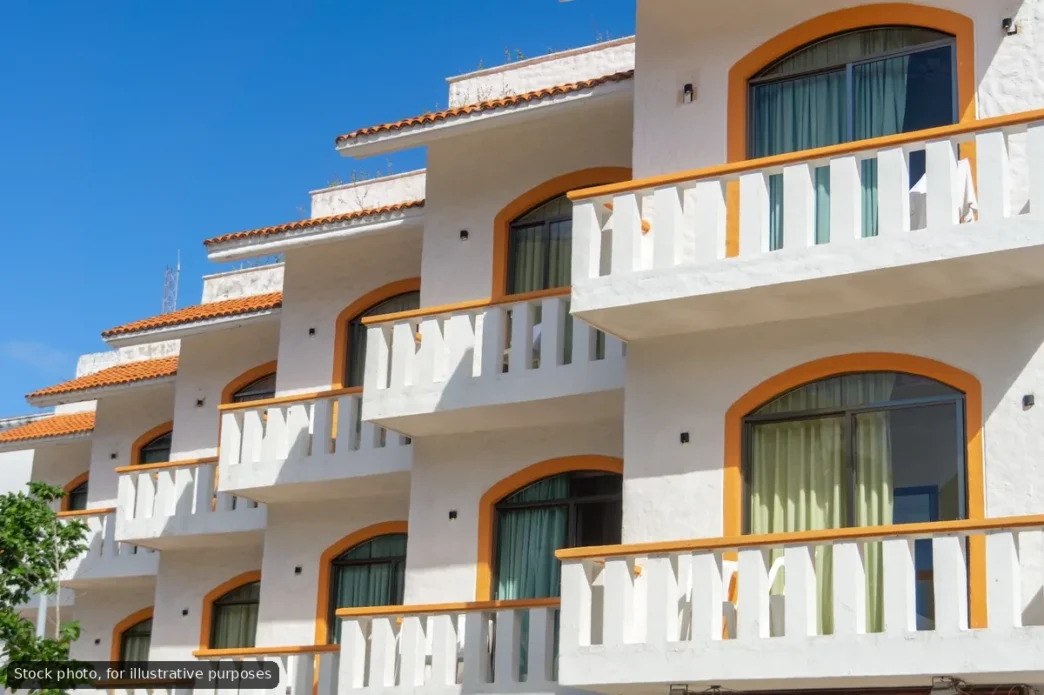
Baja California Sur is preparing new restrictions on apartment construction in central urban areas, starting with La Paz. Governor Víctor Castro Cosío announced this week that state and municipal authorities will meet this week to begin a legal and legislative review aimed at slowing or halting certain multi-unit residential projects until stricter regulations are in place.
The governor did not mince words. “I want to tell you now that I am asking for a meeting on Monday with the Congress, the city council and our colleagues from Public Works to review and make a legal, juridical pause,” he said, according to BCS Noticias. “We are going to stick to the legal side, with injunctions and everything they want, but we are not going to allow any more of these apartments and so on to keep being built in the center of the city.”
Infrastructure Strain Behind the Regulatory Push
Castro Cosío’s announcement reflects growing concern over the rapid conversion of single-family homes into multi-unit buildings often used for short-term visitor rentals. The phenomenon, familiar to many longtime La Paz residents, has been spreading across other parts of the state as well. The governor framed the issue as a question of infrastructure capacity: power, water, public services and urban planning all face additional strain when neighborhoods see sudden increases in density and transient occupancy.
The planned Monday session will include members of the state legislature’s committee on human settlements, La Paz municipal authorities, staff from the state’s urban planning and environment secretariat (SEPUIMM) and legal specialists from the governor’s office. The aim is to map out what regulatory and legislative tools are available and which new measures might be needed to bring apartment development under closer control.
From Announcement to Enforcement
In Baja, a project is never just a project. It is a promise, a budget, a ribbon-cutting photo and, eventually, a test of whether anyone remembered the maintenance plan. The same logic applies in reverse. A regulatory announcement is not yet a regulation, and the gap between intent and enforcement can be wide. Castro Cosío acknowledged this reality by emphasizing that the state will rely on legal mechanisms, including injunctions if necessary, to enforce whatever rules emerge from the review.
For many residents, the question is not whether the initiative sounds good on paper. It is whether it will actually show up where people live. Multi-unit conversions have been altering the character of La Paz’s older neighborhoods for years, and the effect on parking, noise, trash collection and neighborhood cohesion has been a frequent topic at community meetings. The governor’s assurance that “we do not want to harm” property owners or investors suggests that the state is trying to balance economic interests with livability concerns.
What It Means for Developers and Property Owners
What this really means for developers, property owners and foreign buyers remains to be seen. The regulatory environment for real estate in Baja Sur is already layered with municipal, state and federal rules. Adding another tier of controls on apartment construction could clarify some ambiguities or create new ones, depending on how the review process unfolds and what kind of political support or resistance emerges in the legislature.
The practical takeaway for now is that anyone planning to convert a residence into multiple rental units in La Paz or similar urban centers should probably wait. The state has signaled that the rules are about to change, and construction that looks legal today might not look quite as legal by the time the concrete sets.
Whether Monday’s meeting produces immediate action or simply launches a longer review process will depend on how much consensus exists among the officials at the table. What is already clear is that Baja Sur’s government is done treating apartment proliferation as someone else’s problem. The state has decided the problem is theirs, and they intend to do something about it.
