


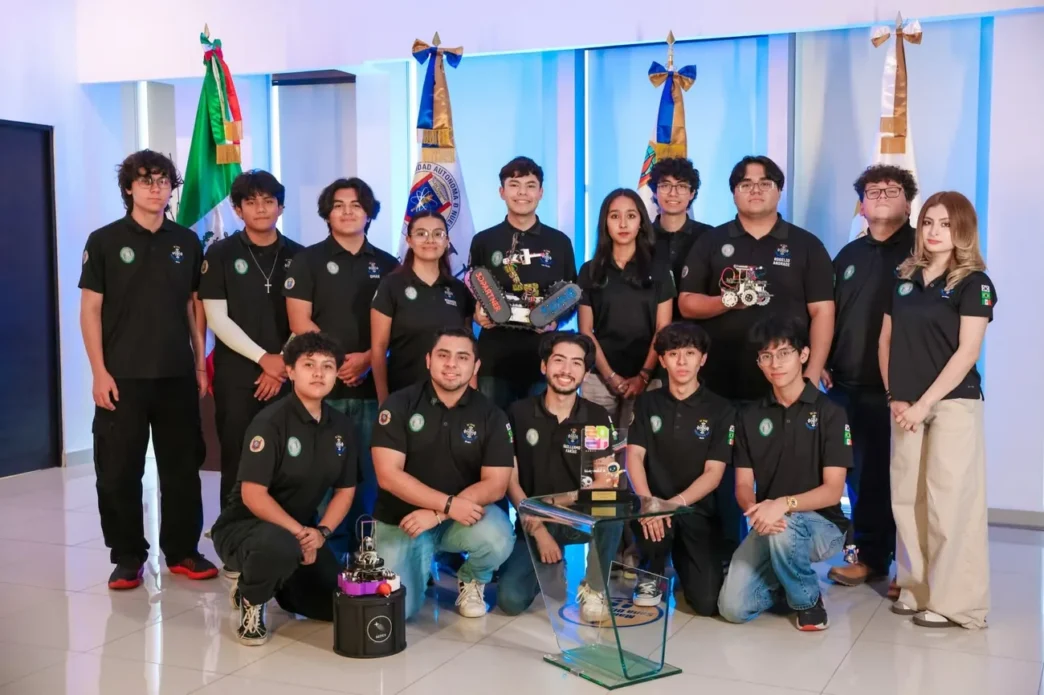
While most eyes were on football this summer, a robotics tournament in South Korea quietly crowned a champion nobody saw coming. At RoboCup 2026 in Incheon, seven engineering students from the Universidad Autónoma de Nuevo León beat teams from China, Germany, the United States, Thailand, Hungary and Greece to win first place in the rescue robotics category.
The winning team — Edaly González, Miguel Marín, Jorge Sánchez, Leonardo Dávila, Guillermo Farías, Miranda Estévez and Tabata Leija — competed as RC UANL. Their robot, Natrix, was built over 10 months in the university lab using 3D-printed parts and biodegradable materials.
The competition ran from June 30 to July 6 and tested the machine’s ability to navigate disaster scenarios: collapsed structures, rubble, staircases, obstacles designed to defeat any prototype. Natrix, weighing 4.5 kilograms and measuring just 24 by 27 centimeters, passed every challenge.
A Robot Built for Rescue
Jorge Sánchez, the project’s mechanical designer, explained that Natrix was engineered for real-world disaster response. The robot crawls through debris, climbs over platforms and transports objects within hostile terrain — exactly the kind of environment search-and-rescue teams face after earthquakes or building collapses.
Named after a constellation shaped like a serpent, Natrix uses onboard cameras to allow operators to navigate it remotely. Each competition round lasted 10 minutes, with scores based on how many tasks the robot completed and how quickly it moved through the course.
According to reports from the competition, the Mexican team’s combination of technical precision and collaborative work set them apart. They also earned the SuperTeam Award for their cooperation with teams from the United States, Greece and Thailand.
What It Took to Get There
The students are all enrolled in the Facultad de Ingeniería Mecánica y Eléctrica at UANL, one of Mexico’s leading public universities. They spent months inside the campus lab, building, testing, and rebuilding Natrix from biodegradable plastics and thermal-resistant materials. Team member Guillermo Farías later said that hearing the judges announce their victory made all the late nights and sacrificed weekends worth it.
This wasn’t Mexico’s first appearance on the international robotics stage. Earlier this year, a student from La Paz won first place at the 2026 Infomatrix competition, another global tech showcase.
RoboCup, now in its 30th year, is one of the most prestigious robotics competitions in the world. The rescue category focuses on machines capable of operating in high-risk environments where human responders face danger. The goal is to advance technology that can save lives during earthquakes, floods, fires and structural failures.
Recognition and What’s Next
During their time in South Korea, the students were received by Mexico’s ambassador to Korea, Carlos Peñafiel, at the diplomatic mission in Seoul. The ambassador honored them on behalf of the country and acknowledged their achievement as a reflection of Mexico’s growing presence in science and technology.
The team also secured automatic qualification for RoboCup 2027, which will be held in Nuremberg, Germany. Between now and then, they plan to continue refining Natrix and competing in other international events.
No billionaire sponsors. No Silicon Valley backing. Just public university students, a 3D printer, and the kind of persistence that tends to produce results. The world builds robots for entertainment. Mexico is building robots to save lives.


