


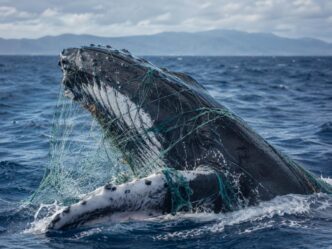
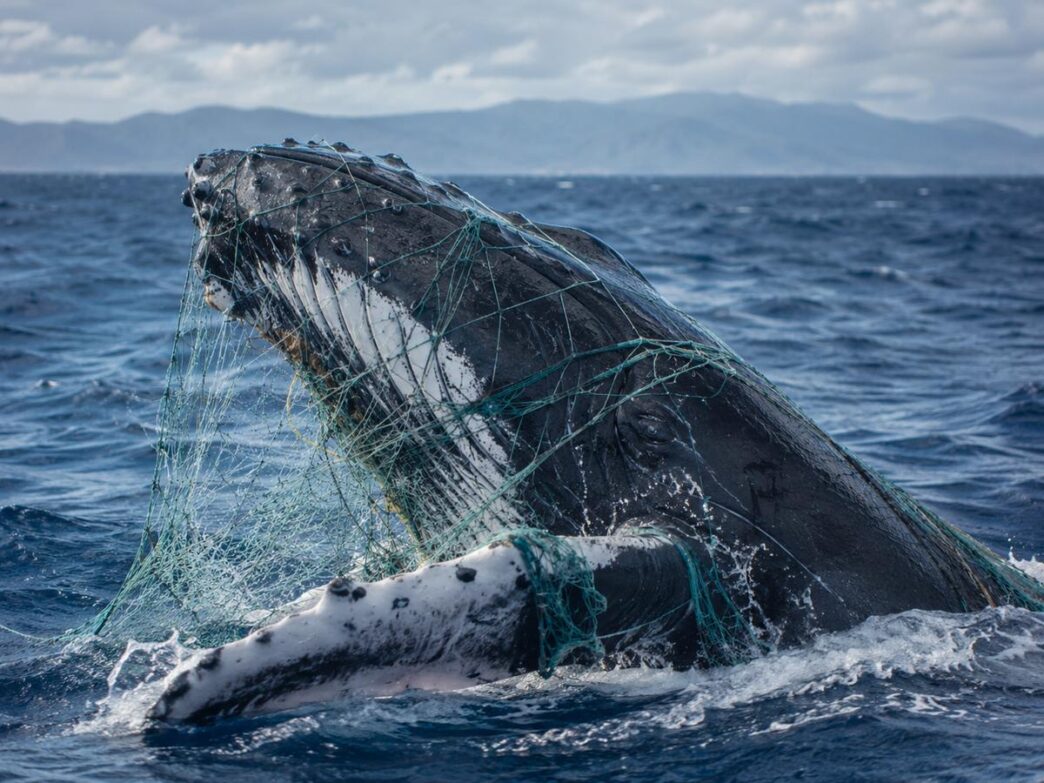
More than 80 entangled whales were recorded in Baja California Sur during the 2024 – 2025 season. That number dropped to 64 during the 2025 – 2026 season, according to data from Mexico’s National Commission of Protected Natural Areas (Conanp).
Among the cases documented this season were a humpback whale found dead near San Evaristo, north of La Paz, with a section of fishing net attached to its body, and another whale discovered off the coast of Pichilingüe. In the latter case, rescue teams were unable to remove the fishing gear entangling the animal.
Francisco Gómez, executive director of the Whale and Marine Sciences Museum in La Paz, said the whale stranded in San Evaristo was discovered during a routine patrol conducted by the Fund for Marine Nature Protection (FONMAR).
National Network Responds to Entanglement Cases
According to Gómez, the Whale Museum is part of the National Network for Assistance to Entangled Whales (RABEN), a specialized response group that has intervened in numerous entanglement cases in recent years.
At Pichilingüe, a specially trained FONMAR team was unable to complete the disentanglement procedure, which involves cutting away fishing gear under specific field conditions.
“What worries us most is the high number of incidents involving fishing gear in which whales become trapped,” Gómez said. “Unfortunately, when the specialized disentanglement team is unable to intervene, the whale’s mobility is greatly reduced.”
“If the netting covers part of the head, the whale may be unable to open its mouth to feed and gradually becomes weaker,” he added. “We believe the death of this whale may have been partly caused by that entanglement.”
Threats Extend Beyond Baja California Sur
Gómez noted that entanglements are not limited to Baja California Sur. Many of the same whales that migrate through the region continue north along routes that extend to Mazatlán and Puerto Vallarta.
Discussing other causes of death among whales, dolphins, and porpoises, Gómez said factors include marine pollution, disease, and, in the case of gray whales, a decline in food availability within their Arctic feeding grounds. “Because of global warming, temperatures have risen significantly,” Gómez said. “Areas that once maintained permanent winter ice cover are disappearing, directly affecting the growth of algae that form the foundation of the gray whale’s food chain on northern seafloors.”
As a result, food resources have become scarcer. Experts estimate that the gray whale population in the region has declined by more than 40 percent.
Gray Whale Populations Show Critical Decline
Benito Bermúdez, Conanp’s regional director for the Baja California Peninsula, has overseen weekly whale censuses in the Vizcaíno Biosphere Reserve for nearly 30 years. He compared population data from the past three seasons. During the 2023 – 2024 season, 883 gray whales were counted in the reserve, including 192 calves, according to data from the Baja California Sur Ministry of Tourism and Economy and Conanp.
In 2024 – 2025, the population declined to 513 whales across Ojo de Liebre Lagoon and San Ignacio Lagoon. More than 80 whales were found stranded in a state of starvation, prompting Conanp to describe the season as one of the most critical in decades.
For the 2025 – 2026 season, survey teams recorded a maximum of 568 whales in Ojo de Liebre Lagoon and 90 in San Ignacio Lagoon. Officials also documented 57 entanglement cases in Ojo de Liebre and seven in San Ignacio.
Last Year Called “Difficult and Critical”
“Last year was truly difficult and critical,” Bermúdez said. “Many emaciated whales became entangled and died from starvation. Calves and juveniles were hit the hardest, accounting for most of the deaths. More than 80 entangled marine mammals were recorded.”
Bermúdez said a comprehensive survey of Baja California Sur’s coastal lagoons will be conducted in May to estimate the number of entangled whales. “We are confident the number will be much lower than the previous year,” he said.
Calf Births Show Signs of Recovery
The number of gray whale calves born during the 2025 – 2026 season is estimated at between 107 and 116, representing about 20 percent of the whales that visited the lagoons during the migration cycle. This marks an improvement over the 69 births recorded in 2024 – 2025, according to Conanp figures.
Bermúdez also warned that El Niño conditions, which bring warmer ocean waters to the Pacific, could shift breeding activity farther north toward the coasts of Northern California and northern Baja California. Such a shift could reduce the number of whales migrating to the southern lagoons of Baja California Sur in future seasons.