


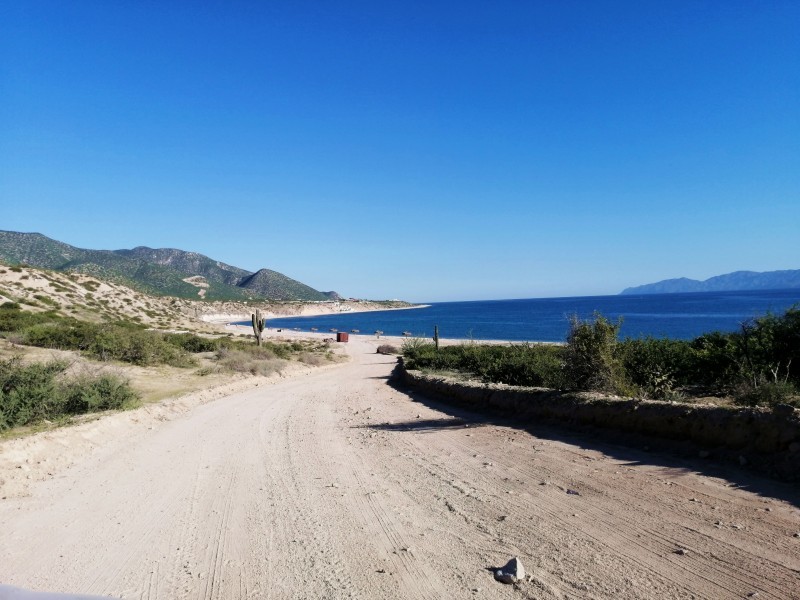
After nearly five years of conflict, residents of El Sargento say authorities at all three levels of government have acknowledged their complaints but failed to deliver a solution. Since 2021, the community has pursued legal action seeking federal intervention to reopen a historically used access road to Agua Caliente beach, which they allege is now controlled by a private association.
The movement has been formalized through the collective Acceso y Conservación de Playas El Sargento. Despite sustained efforts, members say the dispute remains unresolved. Xóchitl Nolasco, a member of the collective, said the conflict began in 2021 when the Ejidal Committee sold Agua Caliente to Conciencia Ambiental Devangari AC. The organization proposed a tourism-residential development known as Mountain Bike, which included plans for a private beach club, according to an Environmental Impact Statement submitted to the Secretariat of Environment and Natural Resources (Semarnat).
Residents say access to the beach was blocked soon after. They accuse the developer of illegally occupying land reclaimed from the sea and removing public infrastructure, including palapas located within the Federal Maritime Terrestrial Zone (Zofemat), without authorization. That same year, the community filed a complaint with the Federal Attorney for Environmental Protection (Profepa).
Later in 2021, large metal containers were installed, further restricting entry for residents and visitors. Access to Agua Caliente, its hot springs, and the route to the nearby community of El Jacalito was effectively cut off.
In 2022, the group gathered nearly 2,000 signatures from residents of El Sargento, La Ventana, and La Paz to request that Agua Caliente be designated as a protected “Destination Agreement” area, which would formalize its public use. The developer responded by filing an invalidation lawsuit (case file 1737/24-EAR-01-2). The case remains unresolved.
The collective argues that the La Paz municipal government is also obligated to restore public access to the road and the federal maritime zone. “Visiting Agua Caliente, a place that has been fundamental to our community for generations due to its beauty and hot springs, is a right we will not allow any company to take away,” the group said.
Efforts to reopen beach access in La Paz were previously promoted by Pavel Castro, now the city comptroller, who began the initiative while serving as municipal secretary during Mayor Rubén Muñoz Quiroga’s first administration. Inspections at the time documented barriers including stone-filled gabions, metal sheets, containers, and earth mounds intended to block entry.
Although the issue was formally documented, federal authorities under former President Andrés Manuel López Obrador warned that the process to restore access needed to be expedited before the end of the administration. No resolution was reached before the term concluded.
Raúl Rodríguez, who served as Semarnat delegate in Baja California Sur during that administration, declined to comment publicly, citing the need for authorization from central offices. Municipal officials in La Paz maintain that the matter remains under federal review.
Residents say conditions continue to worsen. “It stays the same and gets worse every day,” Nolasco said. “This morning I spoke with a neighbor, and it appears Devangari blocked another access point near the arroyos.”
The community is preparing for a meeting with Semarnat in hopes of receiving an update. Ongoing legal disputes also involve questions over land reclaimed from the sea and adjacent surplus lands which residents allege the company is attempting to incorporate into its property.
As a result, the collective has commissioned new studies to determine the precise boundaries between private holdings and the federal maritime zone. Nolasco said that two years ago, representatives from Zofemat, the La Paz city government, Profepa, and Semarnat confirmed the blockage and environmental disturbance, including the removal and alteration of native vegetation. No enforcement action followed.
“They manipulated torote and palo verde trees, many endemic plants. Everyone reported it, but nothing has been done,” she said.
The collective has since established itself as a legal entity and is working to obtain authorization to receive donations to sustain its efforts. The process, however, can take up to two years and requires extensive documentation.
“We are in the process of becoming a donation-receiving entity, but there is strong scrutiny from SAT due to anti–money laundering regulations,” Nolasco said. “Right now, I am compiling two case files because SAT requested supporting documentation from an institution.”

What does this have to do with the Hot Springs?!
The link to this article to agua caliente changed uber drivers- El Sargento Community Fights Blockade of Agua Caliente- Despite reports of a recent agreement between Uber and taxi transportation companies earlier this month, the primary issue for visitors to Los Cabos, airport access for Uber pickups, staysunresolved.