

Do you remember ever experiencing growing pains? Metaphorically, “growing pains” describe the difficulties encountered when a project, organization, or person enters a new phase of development. Through this lens, such pains are a cyclical part of any thriving organism. In honor of Earth Day 2026, I interviewed Víctor Flores, M.B.A., Project Analyst Technician at a leading research centre in L Paz and Mike Martens, owner and operator of Solar Por M, about one of our city’s most pressing growing pains: energy management.
We are all aware of the rapid expansion this region has experienced over the last few years. If you’ve ever considered going off-grid to take advantage of our ample solar access, or wondered why more businesses in the region don’t operate on solar power, join me in this conversation.
Víctor Flores works to bridge the gap between scientific research and regional application. He specializes in technology transfer and institutional management, on how academic innovation can scale to address the infrastructure needs of Baja California Sur. A few years ago, Víctor conducted an economic evaluation assessment on hybrid solar project for a large research facility.
On paper, the project appeared to be cost-effective. However, the electrical infrastructure conditions and the legislation in place at that time presented significant hurdles, which ultimately led to the project being dismissed.
In reality, the electrical needs of a specialized research facility couldn’t rely on the volatility of a basic solar energy framework. “To create a stable, reliable, and effective model, we would require a substantially larger budget and additional technological solutions,” explained Víctor.
Currently, for large facilities, adopting a hybrid system with an uninterrupted supply is often too costly or logistically impossible. “What people often don’t realize is that when energy is sent back to the grid, the excess is redirected to the nearest need. This makes it unsustainable for large-scale users; one single large output can destabilize the entire network. However, in a residential setting, this is an advantage because each unit has different infrastructure, allowing smaller, manageable inputs into the network.” For now, residential units and small businesses remain better candidates for solar hybrid systems than large industrial facilities.
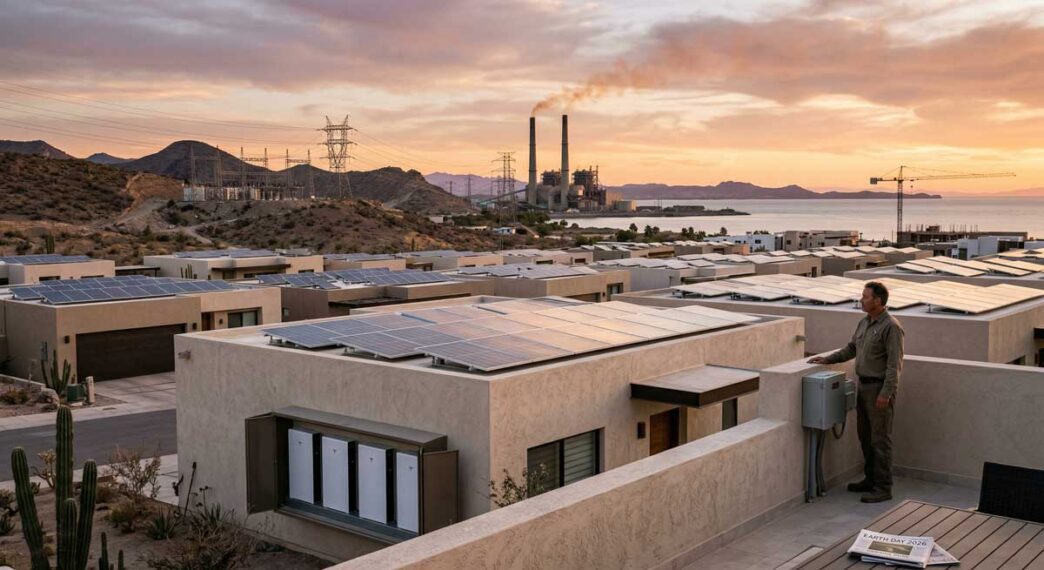
According to Mike Martens, while La Paz is a prime candidate for solar due to its desert climate, consistent sun angle, and minimal cloud cover, Baja California Sur operates as an “energy island” disconnected from the national grid. This limitation, combined with rapid population growth, complicates our local supply network. Managing this demand is critical to preventing total grid instability and reducing our reliance on polluting, petroleum-based power plants.
In Mike’s view, our core issue is grid stability. Our current infrastructure is not a resilient, multi-source energy grid. “Mass consumer behavior, something as simple as cloud cover interrupting solar generation across a neighborhood, creates significant voltage spikes. Battery storage is the only effective way to smooth out these disturbances and maintain a stable supply on both sides of the meter.”
Mike points out that the regulatory landscape is shifting to address these challenges through new battery-priority policies. CFE and CENACE, the two organizations that control the power grid in La Paz, currently restrict traditional solar installations due to their susceptibility to power spikes. However, they are open to grid-tied systems that include significant battery storage. By focusing on systems that provide stable delivery, homeowners can secure case-by-case approval and gain the flexibility needed to build in areas where the grid is overextended.
When asked what CFE’s primary “pain point” is during system reviews, Mike noted, “It is primarily technical. CFE’s core concern is grid stability, not energy reduction for its own sake. The most impactful policy change we could advocate for is redefining what constitutes a ‘compatible’ interconnected system, specifically, requiring a minimum battery-to-solar ratio as a condition of approval. That single standard would do more to protect the grid than most regulatory interventions currently on the table.”
When asked for the most impactful way to support grid stability while gaining energy independence, Mike suggests three steps:
First, audit your consumption. Be honest about what you actually need versus what you waste. Reducing constant, unnecessary energy use, such as running air conditioning in empty rooms, is the fastest way to ease pressure on our local grid.
Second, target your high-draw appliances. Pool heaters, air conditioners, and water heaters are the primary culprits behind energy spikes. Switching to high-efficiency alternatives, such as on-demand water heaters, will immediately and measurably reduce your daily load.
Third, if you are considering solar, get a professional consultation and map your usage. Understand your specific needs and size your solar-plus-storage system correctly. Whether you are aiming for full independence or just enough backup to sustain essential loads during an outage, professional planning ensures you invest in a system that solves the problem rather than adding to it.
To support that process, Mike and his team are launching an AI assistant trained specifically for solar needs in Baja California. It can analyze your CFE bill, ask targeted questions about your usage, and provide personalized insights. To connect with Mike directly, call +1 416 606 3693. Happy Earth Day 2026, and remember to be a responsible steward. – Naailah Auladin for more on my work: www.naailahauladin.com or reach me on WhatsApp at: +52 612 141 8002
Naailah Auladin is a life and relationship doula in La Paz, specializing in guiding individuals and families during periods of emotional trauma, crisis, and mental unrest. She focuses on teaching and inspiring individuals to take responsibility and ownership in participating in their civic duties, prioritizing the well-being of the self first, as she believes that fostering and maintaining well-managed emotional, mental, and physical health is our primary civic duty.