


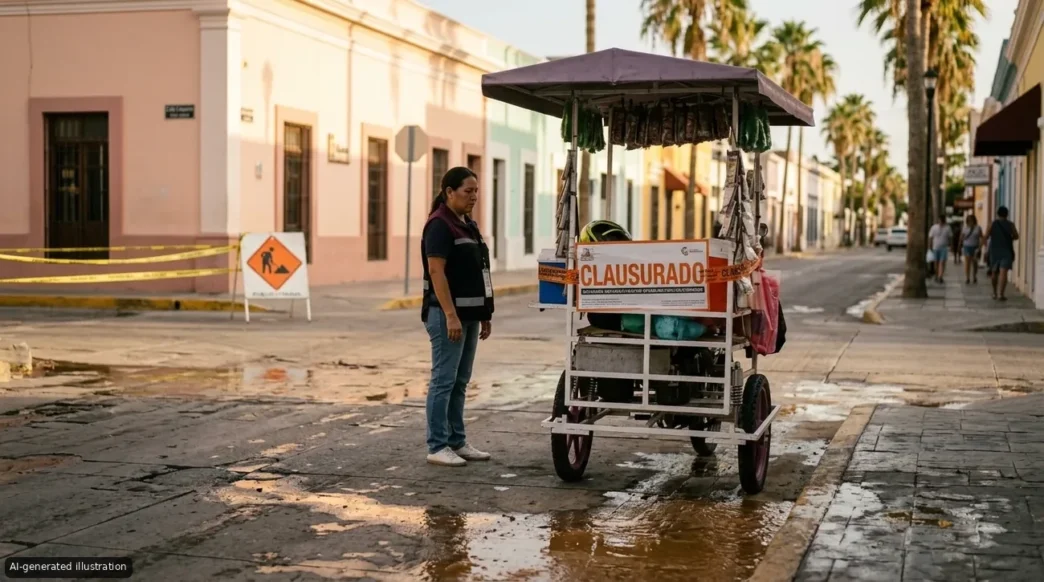
Health officials suspended street food sales across parts of La Paz Monday following Sunday’s heavy rains, which triggered wastewater overflows in several neighborhoods. The temporary ban applies to any area where sewage runoff remains visible, according to the State Commission for Protection Against Health Risks (COEPRIS).
The move marks a swift public health response to a familiar problem: when La Paz floods, so does its aging drainage system.
What Happened After the Storm
Sunday’s downpours sent stormwater rushing through the capital’s streets, overwhelming drainage channels and forcing untreated wastewater to the surface in multiple locations. By Monday morning, COEPRIS inspectors were already removing street vendors from affected zones and ordering fixed-location restaurants to close outdoor seating where tables sat near sewage runoff.
Commission director José Manuel Junco Navarro told El Peninsular that the action is intended to reduce the risk of acute diarrheal illness among residents and tourists. The prohibition remains in place until wastewater spills are cleared and inspectors confirm that food prep areas meet sanitation standards.
Why This Matters for Residents and Visitors
Street food is a daily staple for thousands of La Paz residents and a popular dining option for tourists. The suspension directly affects vendors who rely on public spaces for their livelihood, but it also signals an acknowledgment that the city’s infrastructure cannot always handle seasonal rain without creating health hazards.
The drainage challenges are not new. La Paz officials cleaned streams and drainage areas ahead of hurricane season earlier this year, but Sunday’s storm exposed gaps that persist despite those preparations.
COEPRIS emphasized that the ban is precautionary, not punitive. Vendors can resume operations once the commission verifies that sidewalks and prep areas are sanitized and wastewater is no longer present. Inspectors plan to continue site checks Monday and throughout the week.
What Street Vendors and Businesses Should Do
Junco Navarro urged food vendors to reinforce basic sanitation practices in their work areas. That includes cleaning sidewalks, removing standing water, and ensuring surfaces used for food prep are disinfected before reopening. Restaurants with outdoor seating should verify that tables are not near drainage discharge points.
The commission is asking anyone who observes unsanitary food sales in affected zones to report the violation at www.coeprisbcs.gob.mx or by calling 612-125-0578.
The Bigger Picture
The suspension reflects both the city’s commitment to public safety measures and the ongoing reality that heavy rain continues to test La Paz’s infrastructure limits. While the immediate concern is foodborne illness, the sewage overflow underscores broader questions about drainage capacity, maintenance schedules, and whether the system can keep pace with the city’s growth.
For now, the focus remains on clearing the spills and allowing vendors to safely return to work. Officials have not announced a timeline for lifting the ban, saying only that it will remain until conditions improve.