


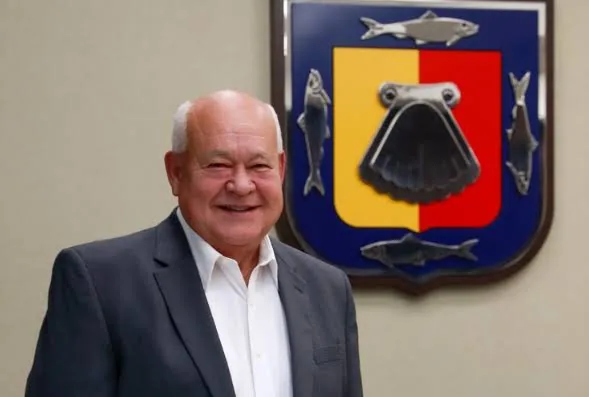
Baja California Sur Governor Víctor Manuel Castro Cosío announced this week that the state may begin refusing permits for new real estate developments in La Paz and Los Cabos unless developers can prove adequate water supplies. His proposal comes as the region faces severe water shortages and rising frustration over gentrification pricing local residents out of their own communities.
In Baja, a project is never just a project. It is a promise, a budget, a ribbon-cutting photo and, eventually, a test of whether anyone remembered the maintenance plan. Castro Cosío is now asking whether Baja California Sur can continue building without that plan—specifically, the plan for water.
During the weekly Mañanera del Pueblo press briefing, Castro Cosío laid out the problem plainly. Where one home once stood in La Paz, condominium towers now rise. Along the coast, near Esterito and across Los Cabos, construction projects continue to multiply. Meanwhile, local reports show municipal water systems are already struggling to keep up.
“We have to make every effort so that buildings are no longer constructed in La Paz,” Castro Cosío said. “Everywhere you go, construction is sprouting up. This has to be regulated.”
The governor acknowledged that property owners currently have the legal right to build on their land as long as they obtain the proper municipal permits. But he argued that right cannot override the growing water crisis threatening the state’s long-term livability.
“It is legitimate for someone to want to build on their land and obtain their licenses,” he said. “But we have a serious water problem.”
Castro Cosío proposed forming a working group with the State Congress and municipal governments to draft legal reforms that would make water availability the primary criterion for approving new construction projects. Under his proposal, developers would need to demonstrate not just compliance with existing zoning and environmental rules, but also proof that their projects will not worsen local water shortages.
“We have to take a firm, legal decision and say: enough. Water for everyone comes first,” Castro Cosío said.
The proposal does not yet exist as formal legislation, and the governor stopped short of declaring an immediate moratorium. But his comments signal a significant shift in how the state government views the relationship between development and resource capacity.
For years, growth in Los Cabos has been driven by tourism, luxury residential projects and foreign investment. That growth has brought jobs and infrastructure improvements, but it has also strained water systems, driven up housing costs and accelerated what many locals describe as gentrification. Neighborhoods that once housed working families now feature short-term vacation rentals and high-end developments that few longtime residents can afford.
Castro Cosío did not shy away from naming that issue. He said the state must address not only water scarcity but also the displacement of local communities by unchecked real estate expansion.
The proposal has immediate implications for developers with projects already in the pipeline. While existing permits would likely remain valid, any new applications could face stricter scrutiny and longer approval timelines. Municipal governments in La Paz and Los Cabos, which currently handle construction permits, would need to coordinate with the state to implement the new standards.
Critics of Baja’s development model have long argued that water planning has lagged behind construction approvals. The state’s aquifers are under pressure, and despite efforts to expand desalination and improve distribution infrastructure, demand continues to outpace supply. Residents in some Los Cabos neighborhoods have faced recurring shortages, and protests over water access have become more frequent.
Castro Cosío’s proposal raises practical questions. How would the state measure water availability for individual projects? Who would enforce the new standards? And what happens to developments already under construction or awaiting final approvals?
The governor said those details would be worked out through the proposed intergovernmental working group. He also acknowledged that changing the legal framework would take time and require buy-in from municipal leaders, many of whom depend on construction permits to generate local revenue.
Still, Castro Cosío framed the issue as a question of priorities. In his view, the state can either continue approving projects and hope the water system catches up, or it can pause growth until infrastructure and resource capacity improve.
“We have to regulate this,” he said. “First is the water for everyone.”
For foreign residents and investors who have watched Baja’s real estate market boom over the past decade, the proposal is a reminder that growth in this part of Mexico has always come with trade-offs. The question now is whether the state government is willing to slow that growth in the name of sustainability—and whether local officials and developers will go along.
The working group has not yet been formally convened, and no timeline has been announced for potential legislative changes. But Castro Cosío’s comments suggest the conversation has moved beyond planning documents and into the realm of political action.
Whether that action materializes as new law, stricter enforcement or simply tougher permit reviews remains to be seen. What is clear is that Baja California Sur’s water problem is no longer something officials are willing to treat as a future concern. It is a present-day constraint on how—and whether—the state can continue to grow.