


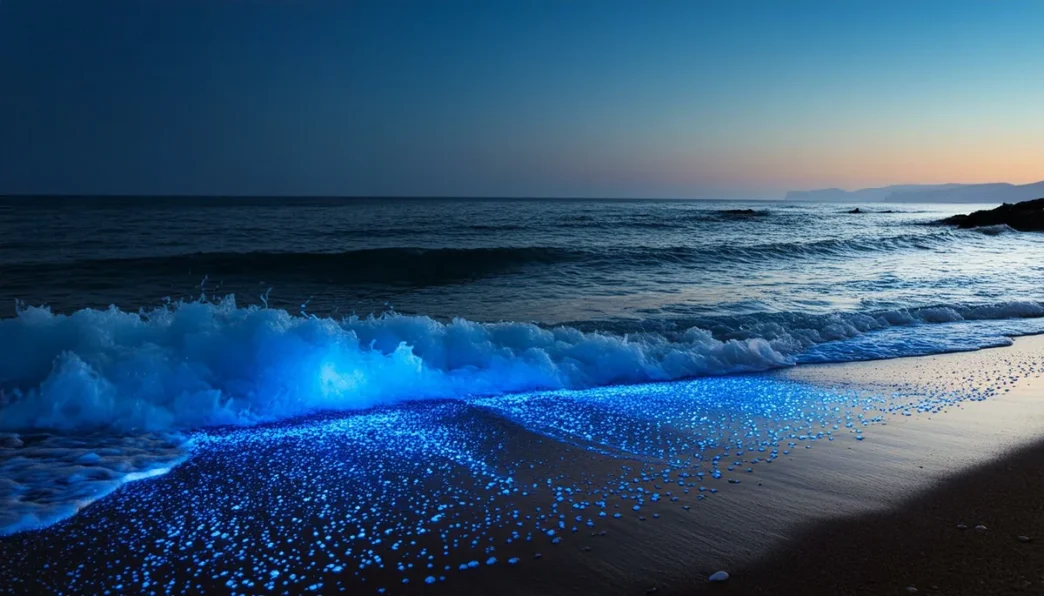
Ever dragged your hand through warm seawater at night and watched it spark blue? You’ve met bioluminescence—microscopic algae reacting to movement with bursts of light. In Baja California Sur, that electric-blue glow isn’t just a lucky accident. A student researcher at the Universidad Autónoma de Baja California Sur has mapped the best times and conditions for catching the phenomenon along the coast.
Daniela Pérez Collazo, a geology student working under the guidance of Dr. Tatiana A. Acosta Pachón at UABCS, is studying the science behind the glow and sharing practical viewing advice for residents and visitors. Her research focuses on the biology, chemistry, and ecology that make the light show possible—and where to find it.
What Causes the Glow
Bioluminescence occurs when living organisms produce light through a chemical reaction. The process involves a molecule called luciferin and an enzyme called luciferasa, which interact with oxygen to create visible light. One of the most efficient natural systems on Earth, the enzyme can be reused repeatedly, allowing continuous light production as long as conditions hold.
The organisms responsible—mostly plankton, algae, and bacteria—use the light as a defense mechanism or to attract prey. When disturbed by movement, they flash blue, creating the glowing effect in the surf, along the sand, or wherever something stirs the water.
El Saltito and Other Prime Spots
According to a local report by El Sudcaliforniano, El Saltito on La Paz Bay is one of the most reliable locations for viewing bioluminescence in Baja California Sur. Surrounded by hills and away from heavy light pollution, the beach offers dark skies and the calm waters that help the glow stand out.
Other popular spots include El Tecolote, near La Paz, which provides views toward Isla Espíritu Santo and access to organized nighttime tours. Santa Rosalía, an old mining town beach with dark sand, also sees the phenomenon during peak season. Each location has its own mix of terrain, accessibility, and services, but all depend on the same environmental conditions to produce the show.
June Through December, New Moon Preferred
The best viewing window runs from June through December, with peak activity during the warmer summer months. The glow is most visible on nights when the moon is down or in its new phase, keeping the sky dark. Low tide also helps—shallow water concentrates the organisms and makes the light easier to see.
Those planning a trip should check the lunar calendar and aim for dates close to the new moon. Clear skies, minimal wind, and calm seas improve the chances of a strong display. Tour operators in La Paz often time their excursions around these conditions, and some offer kayaking trips through bioluminescent waters for a closer look.
Beyond the Beach: Practical Uses
The same chemistry that lights up the surf is now being used in medical and environmental research. Scientists have adapted bioluminescent molecules to track tumor growth, monitor contaminants in water, and study cellular processes in real time. The efficiency of the luciferin-luciferasa reaction makes it a valuable tool in labs worldwide, and ongoing studies in Baja California Sur are contributing to that knowledge base.
Pérez Collazo’s work aims to bring the science closer to the public, explaining not just where to see bioluminescence but why it happens and what it means for the region’s coastal ecosystems. Her research is part of a broader effort at UABCS to document and protect Baja California Sur’s natural resources.
Worth the Trip
For expats, tourists, and longtime residents who haven’t yet experienced the glow, timing a beach visit around the new moon is worth the effort. The phenomenon draws visitors from around the world and offers one of the most striking examples of natural light production visible without special equipment.
Tour operators in La Paz and Cabo can arrange guided trips, or visitors can head to El Saltito or El Tecolote on their own. Either way, the key is dark skies, calm water, and a little patience. If conditions align, the result is a shoreline that seems to light up with every wave—a reminder that some of the best shows in Baja don’t require a stage.