

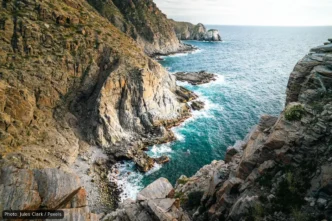

Baja California Sur is launching its first environmental fund — a dedicated mechanism that will pool public and private resources to finance climate adaptation and ecological protection projects across the state. The initiative, born from the State Climate Change Law implemented last year, marks a concrete shift in how the state plans to manage climate threats and natural resource protection.
For residents, tourists and businesses, the fund has practical implications: it aims to finance reforestation with native species, protect local aquifers, build rainwater infiltration systems to replenish groundwater instead of letting runoff reach the sea, and strengthen monitoring of protected natural areas. In a state where water scarcity and coastal erosion are becoming more visible, the fund is intended to move climate policy from planning documents to on-the-ground work.
Antonina Ivanova Boncheva, a professor at the Autonomous University of Baja California Sur (UABCS) and member of the Intergovernmental Panel on Climate Change (IPCC), explained that the fund will draw resources from the state finance ministry, federal environmental programs and international financing mechanisms. One possibility under analysis is directing part of the tourist tax paid by visitors into the fund — a recognition that tourism revenue could help finance the environmental resilience that tourism itself depends on.
Water, Forests and Coastal Protection
The fund’s priority areas include reforestation, aquifer protection and infrastructure that channels rainfall back into underground reservoirs rather than letting it drain to the ocean. Ivanova Boncheva emphasized that these are not abstract goals — BCS has already registered measurable climate-related damage, and the fund is designed to respond to those observed impacts.
The state also plans to seek international climate finance, including programs tied to reforestation and payments for environmental services. These schemes are well established in places like Chiapas and Oaxaca but have seen limited application in Baja California Sur. The fund could change that by creating a structure capable of receiving and deploying such resources locally.
Civil Society and Community-Led Conservation
Unlike some Mexican states, BCS has a relatively strong network of civil society organizations and community groups involved in environmental work. Ivanova Boncheva cited the climate program developed in La Paz with support from the Inter-American Development Bank and the International Community Foundation, as well as grassroots efforts like the Guardianas del Conchalito, ejido conservation projects and the community of Isla Natividad, where residents participate directly in environmental protection and have accessed funding without relying solely on state or federal governments.
The creation of the fund could formalize and expand that model, channeling resources to local communities and organizations already engaged in conservation — a structure that treats climate action as a shared responsibility, not just a government program.
Protecting Natural Areas Amid Budget Cuts
One of the fund’s potential roles is to compensate for reduced federal spending on protected area monitoring. According to Ivanova Boncheva, the number of inspectors responsible for detecting illegal fishing, logging of native species and other violations has declined, even as community members have begun filing reports themselves. She argued that while citizen participation is valuable, it should not replace adequate public financing for conservation and enforcement.
“The environmental fund should also be oriented toward protection, monitoring and surveillance of protected natural areas,” she said.
For expats and seasonal residents who value Baja Sur’s natural landscapes, marine ecosystems and outdoor recreation, the fund represents a potential safeguard — a way to maintain the environmental assets that make the region attractive in the first place. Whether the mechanism lives up to that promise will depend on how transparently it is managed, how consistently it is funded and whether the projects it supports produce visible results.
The fund is part of a broader shift in state development policy, one that acknowledges climate and environmental pressures are no longer background issues but central factors in water availability, coastal stability, tourism infrastructure and quality of life. In Baja Sur, a project is never just a project. It is a promise, a budget, a ribbon-cutting photo and, eventually, a test of whether anyone remembered the maintenance plan. The climate fund will face the same test.
Source Note: This story is based on original reporting by El Sudcaliforniano. It has been independently rewritten and adapted by the Gringo Gazette for our English-speaking readers, with additional context where appropriate.