


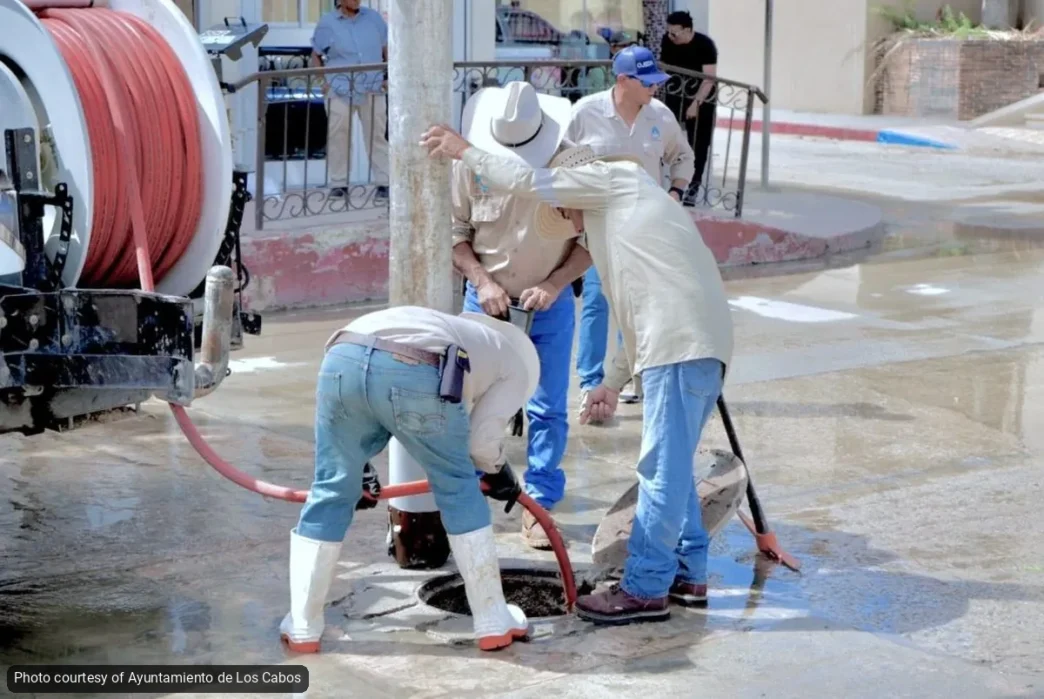
If the street outside your place held water a little too long after this month’s rains, there is now an official number attached to the fix: 37 flood points and 47 manholes across San José del Cabo and Cabo San Lucas have been cleared of accumulated silt and debris. The work is being carried out by OOMSAPAS Los Cabos, the municipal utility that runs the drinking water, sewer and drainage systems, using two hydro-vacuum trucks and dedicated response crews.
The cleanup is a direct response to the runoff and street flooding that followed the recent round of storms, the kind that turns low-lying intersections into temporary lagoons and sends sediment straight into the drainage network. OOMSAPAS says it moved into what it calls its spill-response operational plan almost immediately once the rain let up, giving priority to the low-lying areas and main roads of San José del Cabo, the municipal seat, and Cabo San Lucas. It is the same low-lying terrain that has made drainage a recurring headache in San José’s road network after past weekend rains.
According to José Ojeda García, the utility’s coordinator of operations and maintenance in Cabo San Lucas, the crews didn’t wait around. “We went into action immediately after the weather event passed. We have two hydro-pneumatic units and three permanent response brigades to handle citizen reports and protect the areas hit hardest,” Ojeda García said, describing the extraordinary technical work brigades have carried out since the storms.
Which Neighborhoods Saw the Work
Beyond the manhole count, crews cleaned roughly 500 linear meters of collector pipe in port-area neighborhoods including Tierra y Libertad, Lagunitas and Mesa Colorada, pulling out the dirt and sediment that storms pack into underground lines. That stretch of pipe clearing matters more than it sounds: a clogged collector is often the real reason a street floods long after the rain has stopped, since the water has nowhere to drain once the pipe beneath it is full of silt.
It is the latest piece of a broader pattern this storm season, following earlier crews that tackled round-the-clock sewer repairs in Cabo San Lucas and separate pothole-patching pushes across both cities. None of this means the rainy-season ponding problem is solved for good — Baja’s drainage systems were not built for the kind of rainfall intensity the region has seen in recent years, and silt has a way of coming back with the next storm. But the 37 points and 47 manholes cleared this round are a concrete marker of where crews have already been, and which stretches of road should, at least for now, drain a little faster than they did a few weeks ago.
OOMSAPAS says water-delivery trucks and technical brigades remain on standby and continue coordinating with municipal officials, following direction from municipal president Christian Agúndez Gómez to keep both preventive and corrective work moving on the sewer network. Residents who spot standing water or a blocked drain after the next rain are encouraged to report it directly to the utility rather than wait for it to show up on next month’s cleanup list.