


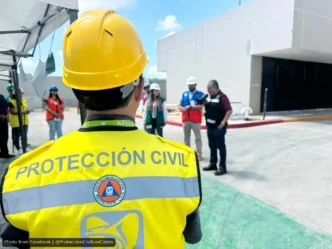
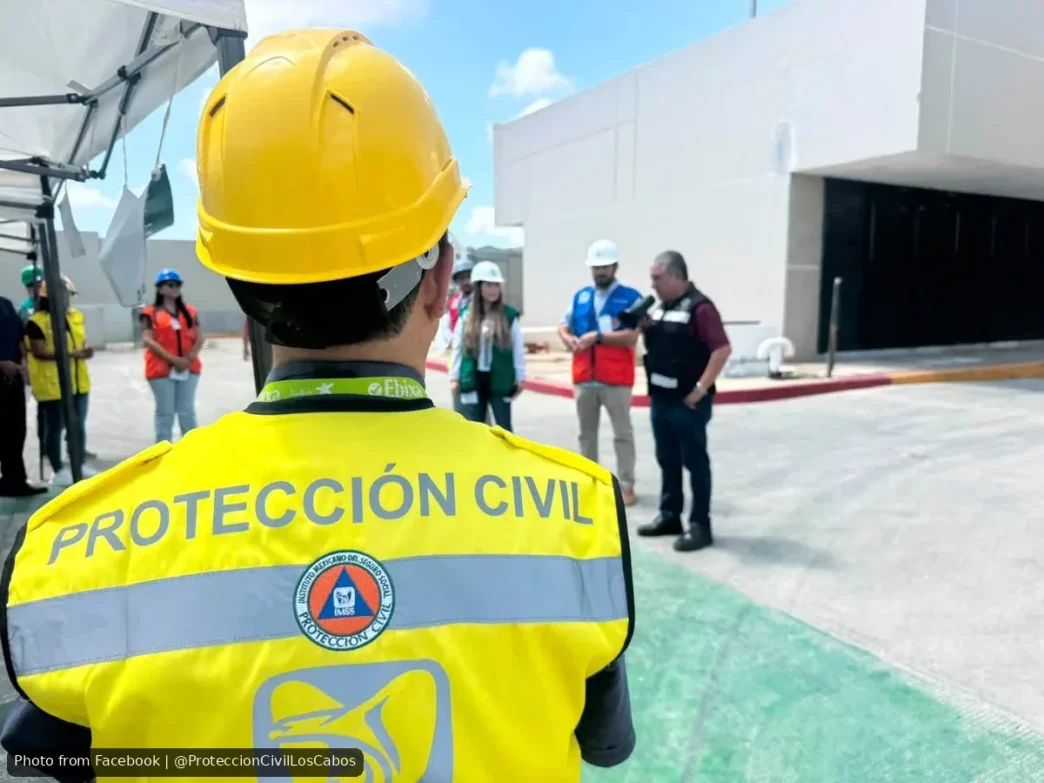
Baja California Sur just finished absorbing landslides and swollen arroyos from tropical storm Polo in the north of the state, while Hurricane Rachel spent part of September keeping forecasters and Civil Protection offices on edge. Now a state lawmaker wants to make sure the agency in charge of managing the next one doesn’t have to ask permission from three layers of bureaucracy to do it.
On Tuesday, Deputy Erick Iván Agúndez Cervantes of the Green Party (PVEM) introduced a bill in the state Congress that would convert the current Subsecretaría de Protección Civil — technically a sub-department buried inside the Secretaría General de Gobierno — into a standalone Secretaría de Protección Civil y Gestión Integral de Riesgos, or Secretariat of Civil Protection and Comprehensive Risk Management. In plain terms, disaster preparedness would get its own seat at the Cabinet table instead of reporting up through someone else’s office, according to El Sudcaliforniano.
“We have to get to the root of it — a subsecretariat of Civil Protection in BCS isn’t enough, it falls short of what’s needed,” Agúndez Cervantes told colleagues on the floor of Congress. He said the push followed months of work with the Autonomous University of Baja California Sur on restructuring emergency management and drafting a new legal framework to go with it.
What Actually Changes
If approved, the state’s executive branch would have up to 18 months to build the new secretariat from scratch — staffing, equipment, budget lines, the works. Until then, the existing subsecretariat keeps doing the job it does now. Employees would transfer to the new agency under their current labor conditions, and any paperwork already in progress would simply carry over rather than restart.
The bill also creates a Fondo Estatal de Protección Civil, a dedicated state emergency fund, though the fine print is telling: the state Finance Secretariat would have 180 days after the decree to write the rules on how much money actually goes into it, and the law itself notes that everything depends on “budgetary availability” each fiscal year. Staff training and certification would roll out in phases over three years rather than all at once.
On paper, the new secretariat would be required to update the state and municipal risk atlases — the maps that flag flood-prone arroyos, landslide zones and other hazards — at least once a year, and consulting them would become mandatory before approving urban development projects. A companion early warning system would fold together the various monitoring tools currently scattered across state and municipal agencies, working alongside Mexico’s National Civil Protection System. That would be a meaningful shift for a state where dry riverbeds have a habit of turning into fast-moving hazards with very little warning.
Filling Gaps Outside the Cities
Agúndez Cervantes also flagged a coverage problem that residents of the East Cape or the Sierra La Laguna backcountry will recognize immediately: emergency response tends to concentrate in the cities and thin out fast once you leave them. “We need to strengthen the municipalities, we need first-response equipment in our oases, in protected natural areas, and across all of our Sudcaliforniano territory,” he said.
The proposal leans on the concept of “comprehensive risk management” — identifying threats before they become emergencies, reducing the conditions that make damage worse, and training both officials and the public to react appropriately. It would also formalize a role for private businesses and civil groups in public education campaigns, building on efforts already underway to improve evacuation planning for seniors and people with disabilities. The bill’s stated motivation reads like a checklist of what BCS has actually lived through in recent years: tropical cyclones, intense rains, drought, wildfires and hazards tied to human activity, according to BCS Noticias.
“The point is to respond to a real need — that has to be our focus, because climate change is here and now,” Agúndez Cervantes said, according to Colectivo Pericú.
The bill still has to work its way through the normal legislative process — committee review, debate, a floor vote — before any of this becomes law, and even then the 18-month buildout clock only starts ticking once a decree is published. In a state that treats hurricane season as an annual guest rather than a rare event, the real test won’t be the vote count in La Paz. It will be whether the new secretariat, if it materializes, is actually staffed, funded and coordinating with municipalities the next time a storm system starts spinning up in the Gulf.