


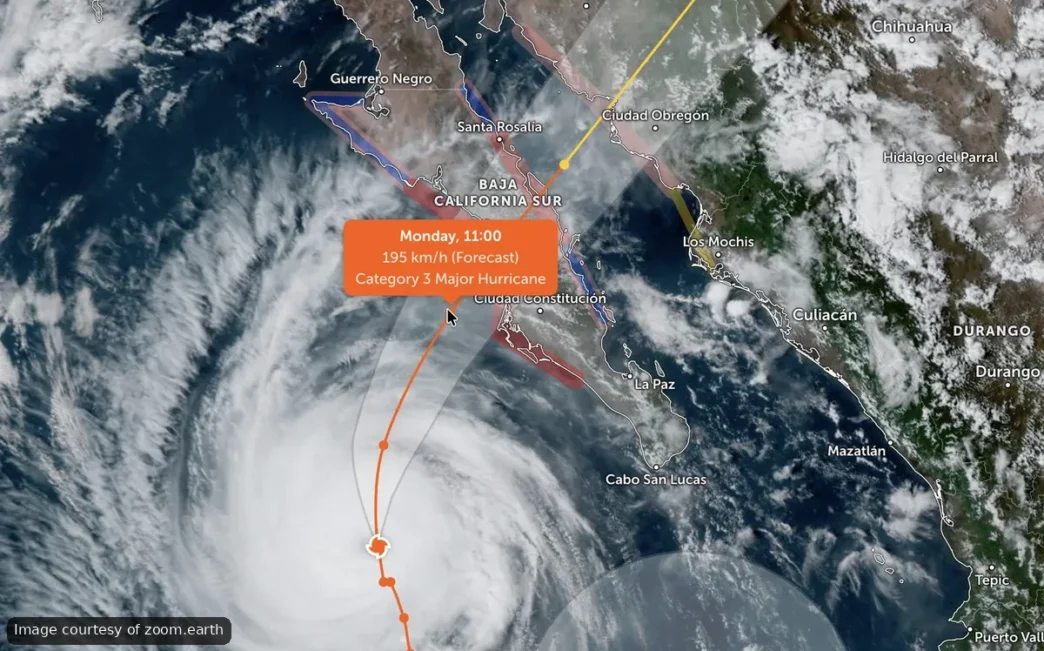
Hurricane Polo weakened from Category 4 to Category 3 overnight Saturday, but that downgrade hasn’t changed much on the ground in Baja California Sur. As of Sunday, September 27, every beach in the Los Cabos municipality remains flagged black, and ports across the state are still closed to navigation.
The storm’s center sat roughly 320 miles (520 km) southwest of Cabo San Lucas as of Saturday night, according to Mexico’s National Meteorological Service (SMN), with sustained winds near 121 mph (195 km/h) and gusts up to 143 mph (230 km/h). It’s a strong storm, but it’s staying well offshore — the bigger issue for Los Cabos and La Paz right now is the ocean swell it’s kicking up, not a direct hit.
Beaches Remain Closed Under Black Flag
Los Cabos beaches have been under black-flag restrictions since early Friday, according to Francisco Cota Márquez, director of Municipal Civil Protection and Risk Management, who told El Sudcaliforniano that “right now every beach in Los Cabos has a black flag, and people need to understand these spaces will stay closed until the effects of this hurricane have passed.” Sunny skies inland don’t mean it’s safe to swim — officials stressed that clear weather on land says nothing about ocean conditions.
Municipal crews from Civil Protection, the Federal Maritime-Terrestrial Zone office (Zofemat), and municipal police are patrolling beaches to pull swimmers out of the water and remind beachfront hotel guests to stay on dry sand, according to the municipal government of Los Cabos. Officials estimate elevated swell will continue for at least another 48 hours, similar to conditions during the recent high-surf closures earlier this season.
Ports Closed to Navigation
Mexico’s Secretariat of the Navy ordered small-craft navigation halted at Puerto Cabo San Lucas, Puerto Los Cabos in San José del Cabo, San Carlos, Bahía Magdalena and Loreto, according to Tribuna de México. The bay at Cabo San Lucas remains shut to shipping traffic by order of the local Capitanía de Puerto, the maritime authority that also closed the port ahead of Polo’s earlier approach this week.
The Navy activated the preventive phase of Plan Marina, deploying more than 1,400 personnel across 14 emergency response brigades, and moved the vessels Usumacinta, Isla Tiburón and Isla María Madre into position to deliver supplies, water treatment equipment and heavy machinery if needed. Los Cabos International Airport remains open but is being monitored closely by Civil Protection.
What’s Next
Polo is expected to keep weakening as it tracks north. Forecasters project it will arrive near Cabo San Lázaro late Monday as a Category 2, make landfall in the Mulegé municipality as a Category 1 Monday night, then cross into the Gulf of California toward Guaymas, Sonora, by Tuesday, according to Tribuna de México, citing SMN data. The SMN has posted a hurricane-wind watch from Punta Abreojos to Santa Fe, with an additional monitoring zone from Punta Eugenia to Punta Abreojos and from Bahía San Juan Bautista to San Evaristo.
Swells of 8 to 11 feet (2.5 to 3.5 meters) are expected to persist along the BCS coast, along with periods of rain and gusty wind. Beach and port closures typically lift once swell drops and the Capitanía de Puerto issues a formal reopening — as happened after past storms when beaches reopened gradually rather than all at once. Visitors and residents should check with hotel front desks, Zofemat, or local Civil Protection channels before heading into the water, and expect the black flags to stay up at least through Monday.
