


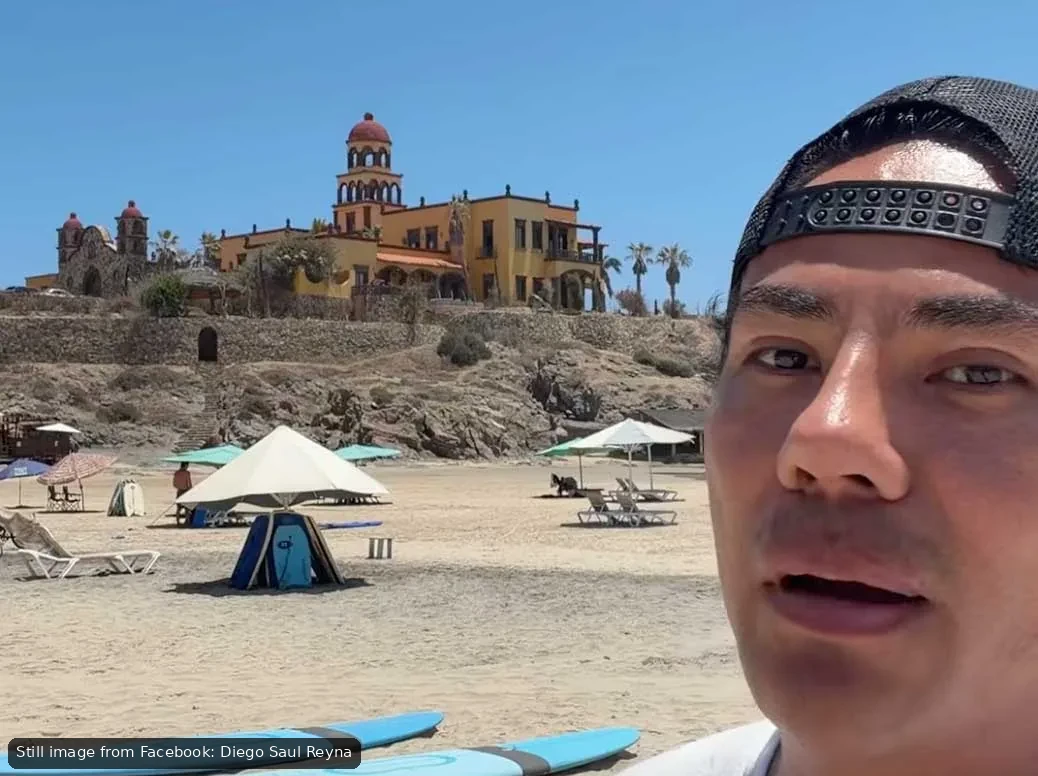
A video denouncing foreign-focused real estate development at Playa Cerritos has sparked fresh debate over gentrification, water consumption and public beach access along the Pacific Coast corridor north of Todos Santos.
Diego Saul Reyna, a Mexican content creator known for environmental and social advocacy videos, posted a walking tour of the Cerritos shoreline that documented a cluster of residential developments marketed in English, priced in US dollars and aimed squarely at foreign buyers. The post has drawn more than 2,000 views and a flurry of comments, rekindling the question of who Baja’s coastal development serves — and what it costs.
“Lo que están haciendo es que se están construyendo de una forma muy poco inteligente y no son para mexicanos,” Reyna said in the video. “En su mayoría extranjeros. Ya vi los letreros y los que los están comprando son personas de otros países. You can see the real estate signs — in English, with prices in dollars. Three hundred thousand dollars.”
Cerritos was, until recently, a quiet surf village known more for its break than its balance sheets. A few palapas, a handful of surf camps and dusty dirt roads gave way to what many locals considered Todos Santos’s less gentrified sibling. That reputation is changing fast. Developers have moved in, and so has the infrastructure that typically follows — gated access, security signage and marketing materials that do not bother with pesos.
Water, Access and the Usual Questions
Reyna’s critique centers on three familiar pressure points in Baja Sur development: environmental impact, water consumption and the risk that public beach access will eventually be restricted or made inconvenient. He compared the trend to other coastal zones in Mexico where development has gradually pushed the public off the sand, a process residents in places like Tulum and parts of Nayarit know well.
“Esto es inaceptable y no podemos permitirlo,” Reyna said. “This is unacceptable and we cannot allow it.”
He was quick to clarify that he does not oppose all development. Restaurants, surf schools and locally owned guesthouses are fine — they create jobs and serve both locals and visitors. The issue, in his view, is large-scale residential projects that treat Cerritos as an offshore real estate product, not as a functioning Mexican community. “No soy el típico hippie que se opone a todo desarrollo,” he added. “Me opongo a la destrucción y gentrificación.”
The video also raised the question of water. Baja California Sur is classified as a region under high water stress, and municipal supplies in La Paz and Todos Santos are already stretched during dry months. Construction requires water. Swimming pools, landscaping and full-time foreign residency require more. Reyna suggested that adding luxury residential projects to an area with fragile supply is asking for trouble down the line.
Foreign Buyers, Local Impact
The observation that real estate in Cerritos is being sold in English and priced in dollars is not new. A walk through the village turns up billboards for Cerritos beach condos with amenities lists that include rooftop gyms, infinity pools and concierge services — features designed for buyers arriving from California or British Columbia, not for families from La Paz looking for weekend beach access.
Reyna posted a similar video earlier this year about Punta Arenas, which racked up more than 416,000 views and sparked parallel concerns. His followers tend to be younger Mexicans frustrated by rising rents, environmental degradation and the sense that coastal land is being parceled off to the highest foreign bidder. Whether his warnings translate into policy or zoning changes is another matter. For now, the video is doing what viral posts do: it is making people talk, and in some cases, forcing residents and officials to acknowledge what is already visible from the highway.
For expats and foreign buyers, the debate is uncomfortable but not unfamiliar. Many came to Baja precisely because it was affordable, accessible and underdeveloped. The same forces that brought them here are now pricing locals out and redrawing the coast. How the municipality of La Paz, developers and the community navigate that tension will shape what Cerritos looks like in five years — and whether it still feels like a surf village or just another gated subdivision with an ocean view.
Source Note: This story is based on original reporting by BCS Noticias. It has been independently rewritten and adapted by the Gringo Gazette South for our English-speaking readers, with additional context where appropriate.