



The ocean absorbs excess heat and energy from greenhouse gas emissions, driving up sea temperatures and disrupting marine biodiversity on which coastal communities depend, according to the United Nations. Rising ocean temperatures can shift or reduce fish populations, threatening livelihoods across the fishing industry.
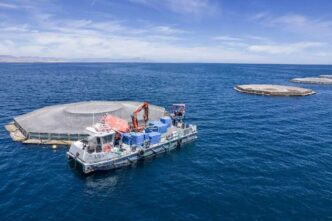
To confront these challenges, Innovaciones Alumbra is supporting Santomar, a regenerative aquaculture company operating in the open waters of the Gulf of California near La Paz.
“We are investing in regenerative warm-water aquaculture because the planet is warming and more regions will become suitable for it,” said Andrew Rhodes, Director of Public Relations and Policy for Alumbra in Mexico. “We are preparing for this future and working to sustainably feed a growing population with healthy, high-quality protein.”
Santomar pioneered the commercial farming of red snapper and totoaba, beginning in 2013 as a research initiative before evolving into a production facility known as Earth Ocean Farm. In 2024, it merged with oyster producer Sol Azul to form the Santomar brand.
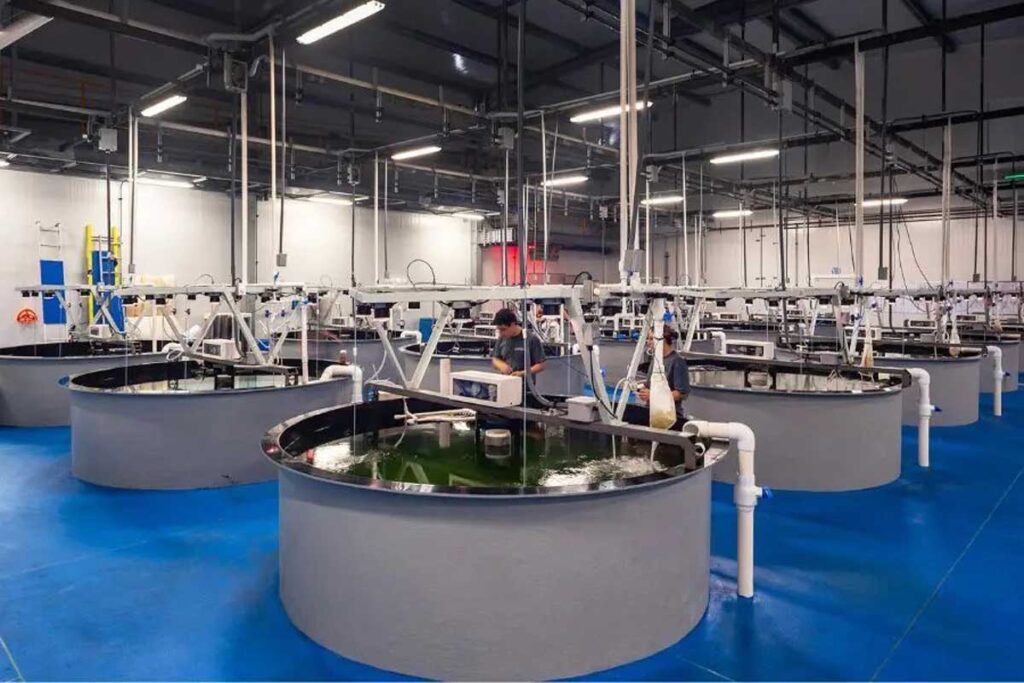
The company now oversees the entire lifecycle of both species, from broodstock housed in recirculating tank systems to incubation areas, larval rearing zones, and pre-fattening facilities. Totoaba fry are fed for about 30 days, while red snapper fry are reared for up to 50 days before they grow into juveniles. The full cycle, from egg to market size, takes 16 months for totoabaand roughly one year for red snapper.
Santomar’s staggered system ensures year-round production, a process refined over more than a decade. “If one phase fails, everything is lost,” said Gerardo García, manager of Santomar’sproduction laboratory. “We need skilled personnel around the clock. If something goes wrong, even a short disruption in feeding, the larvae are affected, and it triggers a chain reaction. Live food farming is cyclical and interconnected.”
The company also runs a genetic improvement program to make red snapper more resistant to rising water temperatures. “We’re selecting fish that tolerate heat better because they can’t migrate to cooler areas,” García explained.
According to Freddy Lapentti, director of Santomar’s Fish Division, this process is not genetic manipulation but selective breeding of the strongest survivors. The goal, he said, is to foster a regenerative aquaculture industry that restores rather than merely sustains ecosystems.
“By ‘industry,’ we mean even small operations that aim not just for sustainability but for regeneration,” added Rhodes.
Santomar’s work extends beyond production. Since 2015, in partnership with local communities and authorities, the company has released an estimated 280,000 totoaba into the wild at SantispacBeach in Mulegé. “We release about 40,000 fish a year, the most we can handle logistically given the terrain,” García said.
Although Santomar has yet to develop methods to track released fish and measure their impact on wild populations, its advances in technology have driven steady production growth. In 2024, the company produced 350 tons of totoaba and 60 tons of red snapper. It aims to reach 520 tons of totoaba and 230 tons of red snapper in 2025, with projections of 700 tons and 400 tons respectively the following year.
“Red snapper has seen the biggest jump from last year,” Lapentti said. Santomar now distributes both species across Mexico and internationally, with products available at Costco locations in Mexico City, Monterrey, Guadalajara, Mérida, Cabo San Lucas, Ensenada, and Tijuana, and soon in Mexicali.
Source: Causa Natura Media
