


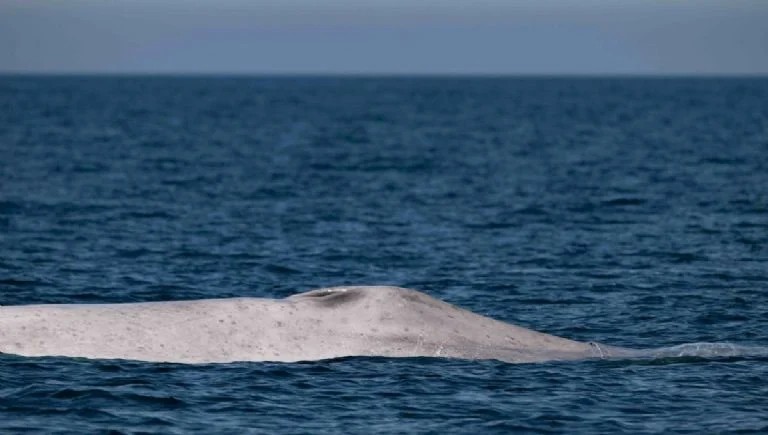
A rare albino blue whale has been spotted in the waters of Loreto Bay National Park, Mexican authorities announced. The sighting, confirmed by the National Commission of Natural Protected Areas (CONANP), is considered an unusual event with significance for research and conservation.
Specialists monitoring the area this season have identified at least 30 blue whales in the protected waters. Among them is a mother traveling with her calf, a sight researchers say underscores the importance of Loreto Bay as a critical habitat for the reproduction and protection of the species.
Scientists attribute the whales’ increased presence near the coast to a surge of nutrients in the sea, which has led to a higher concentration of krill, the whales’ primary food source. The abundance of prey has drawn the animals closer to shore, making sightings more frequent and indicating healthy conditions within the marine ecosystem.
The blue whale, the largest animal on Earth, is classified as endangered by the International Union for Conservation of Nature.
Albinism in cetaceans is extremely rare. Some scientific estimates suggest it occurs in roughly 0.0025% of individuals. Each sighting therefore attracts strong interest from marine scientists and conservationists. Beyond its striking appearance, an albino whale offers researchers a unique opportunity to study genetic variation and better understand how individuals with rare traits survive in the ocean.
The sighting also comes during a particularly active whale season in the region, reinforcing the role of Loreto Bay as a vital refuge where blue whales rest, feed and raise their young.
