



What’s your favorite sweet treat or dulce? Do your sugar cravings make you reach for a chocolate bar, a candy dipped in Tajin and chamoy, or something more complex, like a tortilla de harina filled burrito-style with both queso oreado and ate de guayaba? If you have no idea what the latter is, let alone how it tastes, I invite you to read along with my conversation with Anna-Sara Beltrán, a local baker, about the evolution of Mexican sweets and her mission to incorporate traditional Mexican flavors and nutrition-dense local ingredients in her baking.
“Mexico has a bitter-sweet relationship with sugar,” is how Anna-Sara started the conversation. Acknowledging that Mexico has an issue with its current sugar consumption, she explained that most traditional sweets from this region are the result of the ingenuity of the people, extending the shelf life of what was available. “People knew that food could be preserved either by adding salt or sugar, and they did.” According to her, sugar was a tool of survival, and not a treat. “Imagine if someone owned a guava tree and a goat. Adding sugar to the guava meant that the family could have guava products year-round. Cheese made from the goat’s milk provided an additional source of protein when the milk’s shelf life was limited.”
When sugar is added as a form of preservation, it is added to already dense, nutritious ingredients. A pound of processed candy or chocolate bars does not compare to a pound of any traditional artisan sweets. They might both be high in sugar, but one will have different micronutrients and fiber. Guava, for example, is naturally rich in Vitamin C and antioxidants. The cooking and processing of the fruit pulp often retain some of the original dietary fiber, which helps slow sugar absorption. While heat processing reduces some of its benefits, the finished product still contains nutrients not typically found in refined candy. They use simple, clean ingredients packed with both flavor and nutrition. Eating sweets made in this fashion means that you will be fuller longer and will be less likely to crave more. In other words, you eat less and are satisfied longer.
If you’ve been to any local corner store in the region, you’ve most likely seen trays of staple dulces that are prepared by following the same recipes for centuries with small regional twists. One of these is the coyotas. They are empanada-like cookies that are large and flat, traditionally filled with whatever is available. In this region, you can often find them filled with guava, cajeta, jamoncillo (milk candy), or even cheese. In other regions, they might be filled with pineapple, chocolate, or tamarind. Buñuelos are another typical dulce that creatively repurposes leftover tortilla de harina into a satisfying crunchy snack. To make buñuelos, flour tortillas are deep-fried whole till crunchy, dipped in piloncillo syrup, and coated in cinnamon sugar. (Check out Cooking like a Mexican in the Nov 17th edition of the Gringo Gazette). Another nutrition-dense, underrated sweet is the Alegrías. These rice crispies look alike are made with calcium-packed amaranth seeds and can be purchased at any regular grocery store.
Anna-Sara believes that cooking is a survival skill. According to her, “when you have the grace of the land being fertile, you’ve got to make the most of it.” However, with the accessibility of modern technologies such as refrigeration, using sugar as a form of preservation is no longer as necessary as before. While traditional dulces are made with mostly molasses-based piloncillo sugar, the packaged alternatives are made with white, processed sugar.
Unfortunately, sugar is consumed more for pleasure nowadays and is more readily available. Children gravitate less towards traditional and cultural sweets. The processed alternatives available are formulated, marketed, and packaged to be more exciting to both the palate and the brain. Despite the rich cultural role of sweets, the high consumption of sugar, especially in drinks, has led to a significant public health crisis. Mexico has one of the highest rates of obesity and Type 2 diabetes worldwide. The challenge remains to balance the cultural appreciation for traditional sweets consumed on special occasions with the high daily consumption of processed sugars found in modern diets.
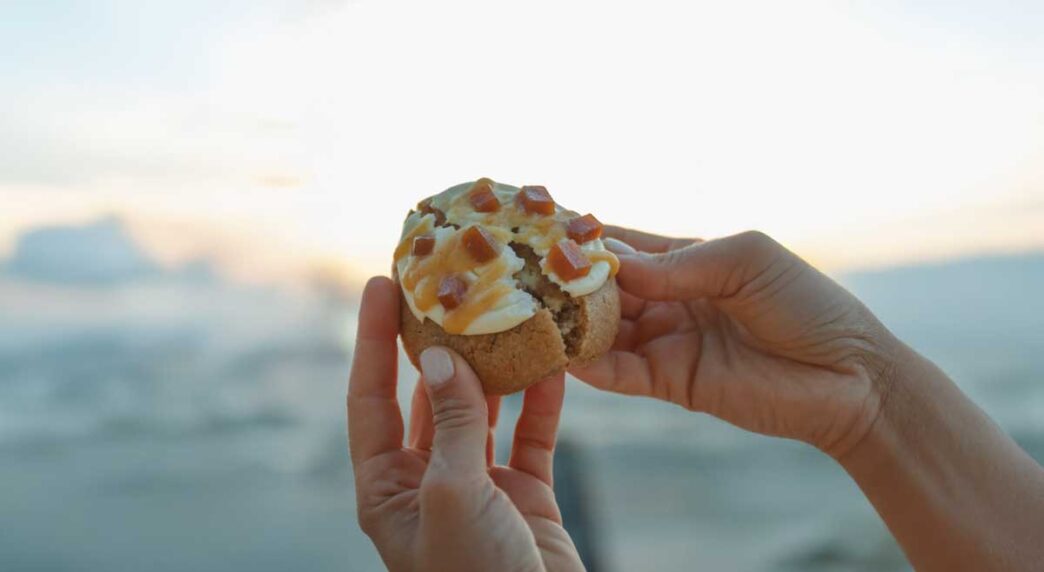
Anna-Sara believes that one of the solutions going forward is to create hybrid baked goods that incorporate complex, nutrition-dense traditional ingredients. Something that can both satisfy the sweet tooth and stop the sugar cravings. Her baking foundation comes from her dad. The latter was trained in bread making and specialized in French pastry in Santa Rosalia before moving to La Paz, where he passed his wisdom onto her. As a seasoned baker, Anna-Sara loves crafting fusion cookies as an attempt to not only revitalize and promote wholesome traditional Mexican sweets and flavors, but also to showcase that our relationship with sugar can be transformed.
Anna-Sara and I shared a simple yet satisfying burrito stuffed with a cheese named “queso oreado” and a fruit paste concentrate called “ate de guayaba” during our conversation. If you’d like to try her specialty baked goods, such as her signature cookie made with guava and Cotija cheese, you can reach her directly at @monarcadelibakery on Instagram.
Naailah Auladin for more on my work: www.naailahauladin.com on WhatsApp at: +52 612 141 8002
Naailah Auladin is a life and relationship doula in La Paz, specializing in guiding individuals and families during periods of emotional trauma, crisis, and mental unrest. She focuses on teaching and inspiring individuals to take responsibility and ownership in participating in their civic duties, prioritizing the well-being of the self-first, as she believes that fostering and maintaining well-managed emotional, mental, and physical health is our primary civic duty.