


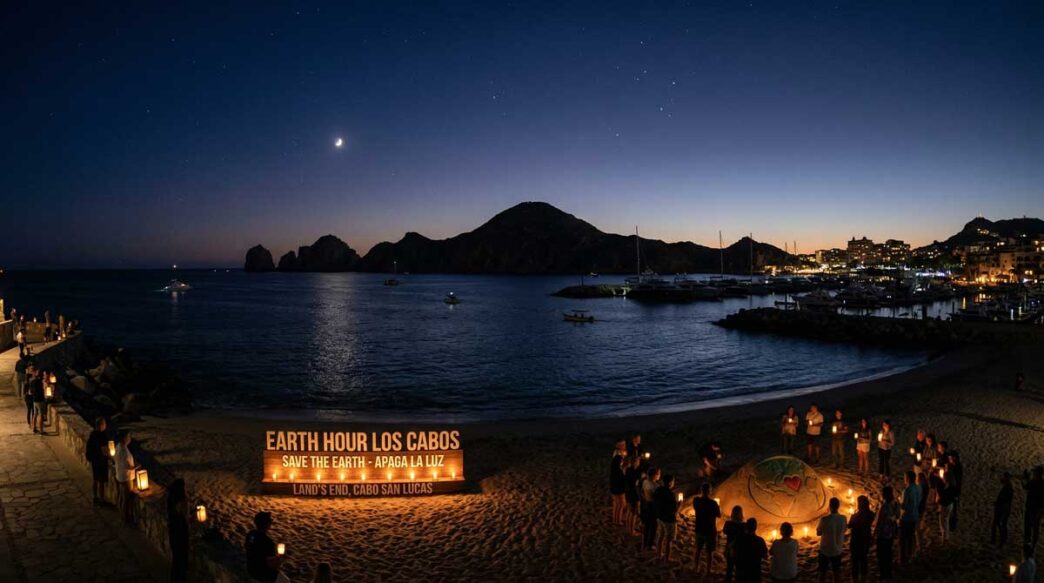
On March 28, Los Cabos will turn off all non-essential lights for one hour, joining cities in more than 190 countries participating in Earth Hour. The initiative, organized by the World Wide Fund for Nature (WWF), calls for switching off non-essential lights on the last Saturday of March each year to draw attention to climate change.
Los Cabos has taken part in the initiative since 2017. Hotels such as Casa Dorada and Marquis have participated since the beginning, while others are joining for the first time this year, including Hotel El Ganzo and Grupo Transcabo. Several properties, including Hacienda del Mar, Grupo Solmar and Grand Fiesta Americana, have participated for four years.
Although largely symbolic, Earth Hour can have measurable effects. The Marquis Los Cabos hotel, which has participated since 2017, reports that electricity consumption drops between 8% and 12% during the hour when non-essential lights are turned off.
In Los Cabos, Earth Hour reflects a broader transformation within the tourism sector as it moves toward decarbonization, and a responsible tourism model aligned with the United Nations Sustainable Development Goals (SDGs).
The boutique hotel La Valise Los Cabos, for example, is energy self-sufficient and operates completely off-grid, meaning it is not connected to the conventional electrical system. Its daily operations are powered entirely by a solar panel system integrated into the property from the time it was built.
NEST Baja offers another example of energy efficiency. Its architectural design maximizes natural light to reduce electricity consumption and is complemented by photovoltaic systems that minimize dependence on the commercial grid. Other properties, including Solmar Hotels & Resorts, have installed multi-stack systems that reduce gas consumption for heating water. They have also transitioned to intelligent LED lighting systems to reduce electricity use without sacrificing comfort.
Grand Fiesta Americana Los Cabos has also implemented an energy-saving program with monthly targets aimed at reducing its carbon footprint, along with investments in solar panels. The Marquis hotel has similarly transitioned to LED lighting systems and optimized pool heating by regulating consumption according to weather conditions. Casa Dorada Los Cabos Resort & Spa reports savings of up to 645 kilowatt-hours (kWh) during Earth Hour while maintaining permanent efficiency programs, including the use of solar energy to heat 75% of the water in its pools.
Even properties participating in Earth Hour for the first time already have sustainability initiatives in place. Hotel El Ganzo uses solar heaters for boilers and pools and operates an intelligent air-conditioning system designed to optimize energy performance.
Energy transformation in Los Cabos extends beyond hotels and into transportation. Hacienda del Mar Los Cabos, in addition to LED lighting systems and internal efficiency programs, has installed charging stations for electric vehicles, promoting the adoption of cleaner technologies.
Tourism transportation company Grupo Transcabo will also participate in Earth Hour this year. Of its fleet of 130 vehicles, more than 30% are low-emission 2024–2025 models. The rest undergo low-emission verification certification through Mexico’s Ministry of Environment and Natural Resources (Semarnat).
Rodrigo Esponda, director of the Los Cabos Tourism Board (FITURCA), said responsible tourism in the destination depends on collaboration across the entire sector. “In Los Cabos, responsible tourism is understood as a chain in which every link is essential. That includes guests and visitors, who not only demand sustainable tourism experiences but also help amplify sustainability,” he said.
From initiatives such as electronic key systems at Solmar to slow-travel experiences and farm-to-table cuisine at NEST Baja, he said the goal is to show that luxury and environmental responsibility can go hand in hand.
“We understand sustainability as a shared responsibility, and we are building an ecosystem where low-emission mobility, bioclimatic architecture, and water and energy management align with the philosophy of our visitors to decarbonize our destination. Participating in Earth Hour reaffirms that every link in our tourism chain is committed to this regenerative vision,” a spokesperson said.
Earth Hour in Los Cabos 2026 will take place Saturday, March 28, from 8:30 p.m. to 9:30 p.m. local time.