


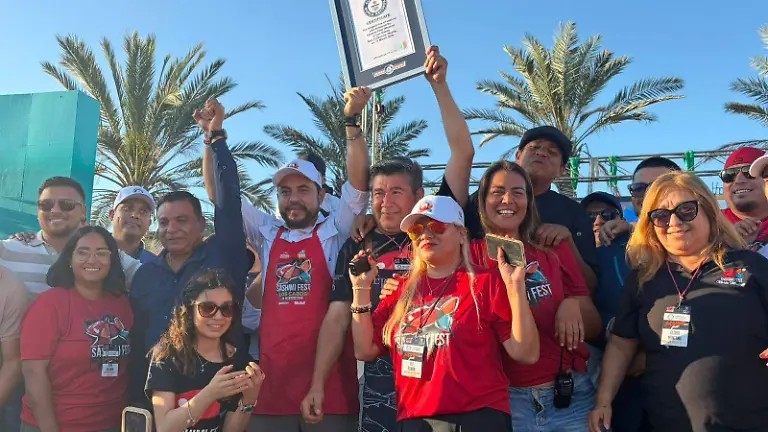
On March 14, 2026, Los Cabos surpassed Mazatlán by creating the world’s longest sashimi line. Red onion, serrano pepper, cucumber and jack mackerel were the main ingredients used in the Guinness World Record attempt in Los Cabos. Last Saturday at the Sashimi Fest in San José del Cabo, the record-breaking effort produced the longest sashimi dish in the world, totaling 23,040 thin slices.
Held as part of the San José del Cabo Traditional Festivals, the annual Sashimi Fest usually features a competition among chefs preparing the best sashimi using fish from Baja California Sur. In 2026, however, the event took an unexpected turn when Los Cabos secured a place in the Guinness World Records.
Around 5 p.m., with nearly 600 participants, including chefs, culinary students, locals and tourists, an official Guinness adjudicator announced that Los Cabos had officially taken the title from Mazatlán. In previous years, Mazatlán created a sashimi line about one kilometer long using 19,000 slices of fish.
Chucho Montaño, director of the Sashimi Fest, said the event marked the culmination of months of preparation.
“Today I was fortunate to be here with all of you witnessing this official Guinness World Record attempt for the longest sashimi line in the world, a very difficult task that had previously been set as a goal for the first time in Mexico,” Montaño said.
With an initial target of 19,103 pieces, participants managed to surpass the record. Although the main event took place on March 14, planning for the attempt began six months earlier. After weeks of preparation, the mise en place, including the organization and preparation of ingredients, was completed on March 13.
More than 300 culinary students from ITES Los Cabos, a public higher education institution in Baja California Sur, and Universidad Mundial participated in the effort. Students cut the fish into 5-by-6-centimeter slices while also preparing vegetables and sauces.
Organizers initially aimed to create a 1.5-kilometer sashimi line with 28,960 slices, but the final count reached 23,040 pieces.
“We have an official figure of 23,040 pieces,” Montaño said. “Although I regret to deliver some terrible news because Mazatlán loses the official title, it now belongs to San José del Cabo. Thanks to the team here with me, we can confirm that Los Cabos is now in the global spotlight,” Montaño said. “It’s worth celebrating. Thanks to the community of San José del Cabo and Los Cabos for supporting projects filled with dreams that help us make history, gastronomic history.”
Sashimi arrived in Baja California Sur largely through Japanese fishing techniques, particularly the ikejime method used to preserve fish quality, combined with the region’s abundant, high-quality seafood caught by local fishermen. Over time, this influence evolved into what is now known as “Mexican sashimi,” a local style that uses freshly caught fish such as yellowtail and has become popular in coastal communities.
A week before the event, Montaño and CANIRAC, Mexico’s national organization representing and promoting the restaurant industry, announced that the “panguero” or “choyero” style of sashimi should be recognized as a regional product. With this declaration, Baja California Sur now officially recognizes sashimi as part of its regional cuisine.
