


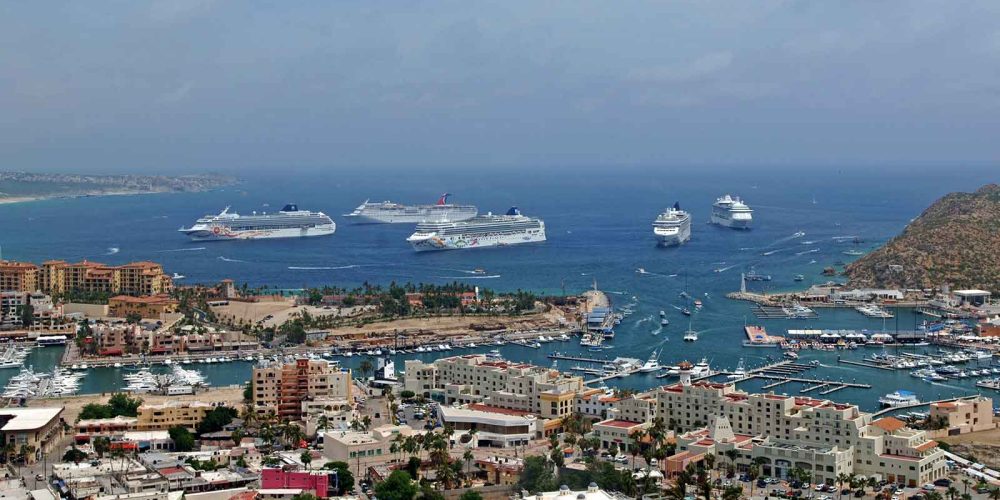
More than 1.2 million cruise ship passengers arrived in Baja California Sur during the 2025 calendar year, primarily in Los Cabos, La Paz and Loreto, generating a significant economic impact across the region. The head of the Ministry of Tourism and Economy, Maribel Collins, said the figure represents a 52.6 percent increase compared with 2024.
“I know the number increased significantly, especially in December, after 57 cruise ship arrivals in Los Cabos,” Collins said. She explained that cruise tourism boosts not only hotel and tour occupancy, but also local commerce, transportation services and the sale of regional products, particularly in areas near docks and boardwalks.
Narciso Agúndez, director of the Integral Port Administration (API), reported that La Paz recorded 40 cruise ship arrivals in 2025 through the port of Pichilingue, with an estimated 120,000 passengers disembarking in the state capital.
“Each cruise ship arrival generates between 3 and 4 million pesos ($170,000 to $230,000 USD) in economic activity,” Agúndez said. “This estimate is based on information gathered directly from cruise passengers. Some spend little, others spend more, but the average expenditure is about $55 per person.”
He said the economic impact is primarily distributed among tourism services, restaurants, local transportation and the purchase of handicrafts. Agúndez added that growth is expected to continue, with 51 cruise ship arrivals already scheduled for La Paz in 2026, a 27 percent increase compared with 2025.
Agúndez attributed the increase to the modernization of port infrastructure and coordination with cruise lines to accommodate larger vessels, expanding the port’s economic potential. He also highlighted the case of Loreto, which records one of the highest disembarkation rates in the state despite lacking a docking pier.
“More cruise passengers disembark in Loreto, where there is no dock, than in La Paz,” Agúndezsaid. “We have measured this ourselves. In La Paz, about 70 percent disembark, while in Loreto the figure reaches 86 percent. This is despite passengers having to transfer by tender from the cruise ships.”
He said the data underscores the need for continued investment in port infrastructure and tourism services in the area.
Governor Víctor Castro said the growth of cruise tourism is closely linked to the financial and operational management of the Port Authority, as well as coordination among state agencies.
“How could we not be committed to transparency and the proper use of resources so that people see the benefits in their communities?” Castro said. “It’s not just about managing funds correctly, but about having a real social impact and shared well-being.”
Authorities said preliminary assessments place Baja California Sur among the states with the highest growth in cruise tourism nationwide in 2025. Agúndez announced that API has allocated 30 million pesos ($1.7 million USD) in its 2026 budget to build an inclusive children’s park on the fiscal dock along the La Paz malecón.
The project includes an eight-meter-high pirate ship accessible to children with motor disabilities, inclusive palapas, games for all ages, adapted pathways, shaded areas and spacious bathrooms. Plans also call for a tourist information screen and the renovation of the existing lighthouse. The bidding process is expected to begin in early 2027.
Elsewhere in the state, API completed reconstruction of the pier in Loreto and is currently rehabilitating the fishermen’s pier in the same town. In Puerto San Carlos, a reconstructed pier was inaugurated in 2025 following a 21-million-peso ($1.2 million USD) investment by the Hallmark company. The project supports coastal and sport fishing, as well as whale-watching tourism, benefiting approximately 120 vessels operating in Baja California Sur.